
The Ultimate 3-Day Belgrade Itinerary: Land & Water Edition

Three days are enough to understand Belgrade, but only if you explore it as more than a collection of famous attractions.
The strongest first-time itinerary begins with Old Belgrade and the rivers, continues through Vračar and the city’s Yugoslav story, and finishes across the Sava in New Belgrade and Zemun.
This order is geographical, but it is also historical.
On Day 1, you stand above the Sava–Danube confluence at Belgrade Fortress and then see the same landscape from the water. On Day 2, you move through the religious, scientific and Yugoslav institutions that shaped modern Belgrade. On Day 3, you cross the Sava to compare postwar New Belgrade with old Zemun, two neighbouring districts that could hardly look more different.
This itinerary is designed for a first visit. It includes essential landmarks, neighbourhood time, realistic transport and enough flexibility for museums, weather, Monday closures and seasonal cruise schedules.
Three Days in Belgrade at a Glance
Day | Theme | Main areas | Essential experience |
Day 1 | Old Belgrade and the rivers | Republic Square, Knez Mihailova, Kalemegdan, Dorćol, Sava and Danube | See the confluence from above and then from the water |
Day 2 | Faith, science and Yugoslav history | Vračar, Saint Sava Temple, Nikola Tesla Museum, Museum of Yugoslavia | Understand the cultural identities behind modern Belgrade |
Day 3 | The city across the Sava | New Belgrade and Zemun | Compare Yugoslav modernism with a historic Danube town |

The short version
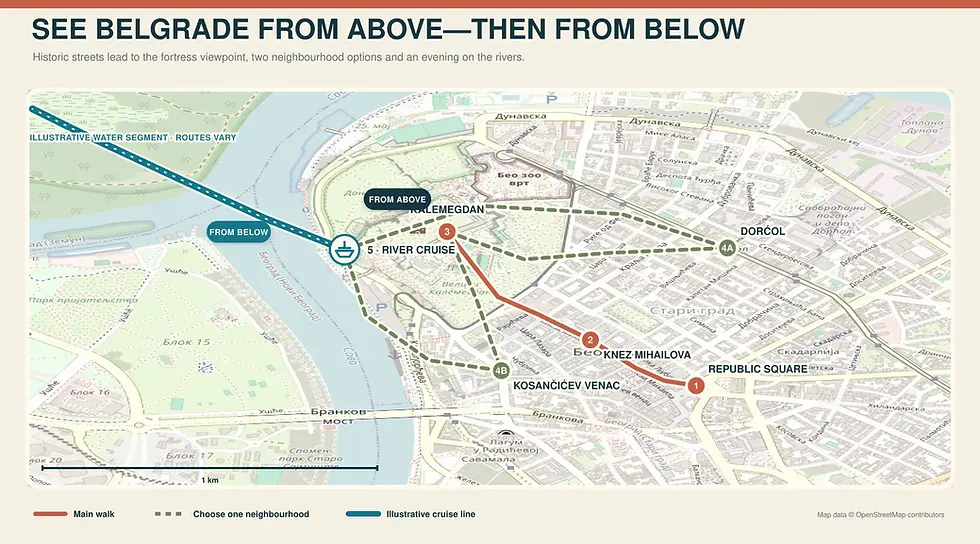
Day 1: Republic Square → Knez Mihailova → Belgrade Fortress and Kalemegdan → Dorćol or Kosančićev Venac → sightseeing cruise on the Sava and Danube → dinner
Day 2: Kalenić Market → Vračar streets → Saint Sava Temple → Nikola Tesla Museum → Museum of Yugoslavia and House of Flowers → choose your evening
Day 3: New Belgrade architecture or Ušće → Museum of Contemporary Art when open → Palace of Serbia exterior → old Zemun → Gardoš → Zemun Quay
Is Three Days Enough for Belgrade?
Yes. Three days are enough for a rewarding first visit if you stay in Belgrade rather than using one of the days for a distant excursion.
In three days, you can experience:
the historic centre;
Belgrade Fortress and Kalemegdan;
the Sava–Danube confluence;
Dorćol or Kosančićev Venac;
the city from the water;
Saint Sava Temple and Vračar;
Nikola Tesla and Yugoslav history;
New Belgrade;
Zemun and the Danube riverfront.
Three days are not enough for every museum, every neighbourhood, Avala, Ada Ciganlija, Topčider, Novi Sad and a full nightlife programme. Trying to fit all of them into one city break creates an itinerary that looks impressive on paper and feels exhausting in practice.
This plan prioritises the places that help first-time visitors understand Belgrade, not simply collect photographs of it.
Before You Begin: How to Use This Belgrade Itinerary

Treat the day numbers as themes, not fixed weekdays
Museum schedules should determine the final order.
As of August 2026:
the National Museum of Serbia is closed on Mondays;
the Museum of Yugoslavia is open Tuesday to Sunday and closed on Mondays;
the Museum of Contemporary Art is closed on Tuesdays;
the Nikola Tesla Museum currently opens every day, with shorter Monday hours and guided presentations at scheduled times.
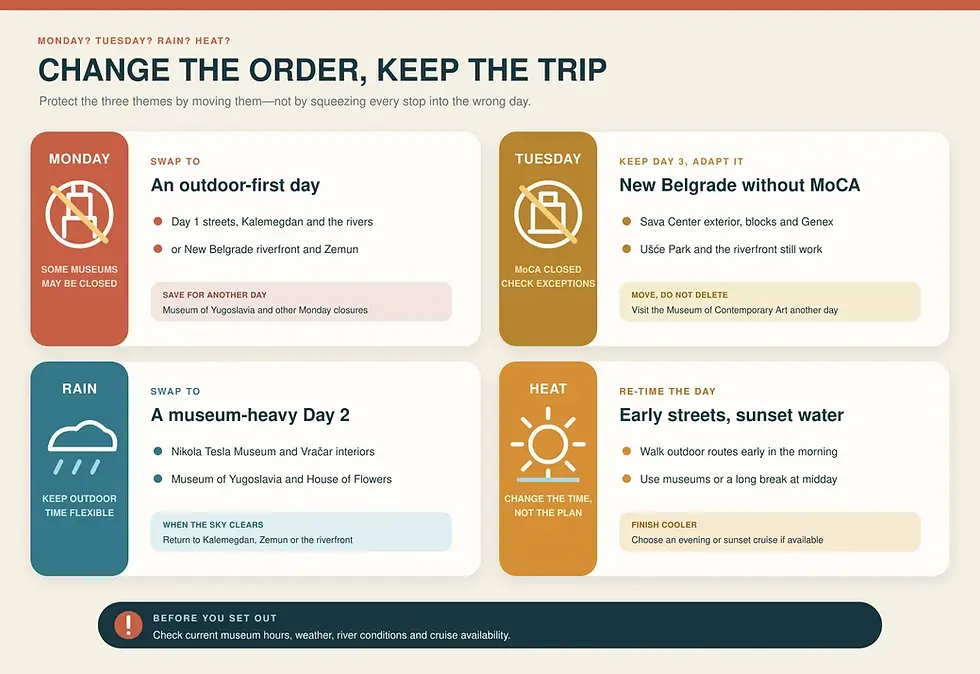
If your trip includes Monday, use it for the outdoor-heavy sections of Day 1 or Day 3 and move the Museum of Yugoslavia to another day.
If your New Belgrade day falls on Tuesday, explore the architecture and Ušće Park but do not plan around entering the Museum of Contemporary Art.
Always check official schedules shortly before visiting because exhibition installation, holidays and temporary closures can affect access.
Reserve only the experiences that control the day
Belgrade rewards flexibility. Leave space for coffee, markets, long lunches and streets you did not plan to notice.
The time-sensitive elements are more likely to be:
the guided presentation at the Nikola Tesla Museum;
a specific temporary exhibition;
a performance or event;
a restaurant you genuinely care about;
your river-cruise departure.
Public river-cruise schedules change seasonally, so choose your cruise date first and move the three daily themes around it when necessary.
Stay central for the easiest version
Stari Grad, Dorćol, Republic Square and central Vračar are practical bases for a first three-day visit.
New Belgrade and Zemun can also be good places to stay, especially if you prefer a quieter riverfront or modern accommodation, but you will use transport more often to reach the historic centre.
Do not try to walk all of Belgrade
Old Belgrade, Dorćol, Vračar and Zemun are rewarding on foot once you reach them. The distances between those areas are another matter.
Use public transport, a taxi or a ride app between:
Vračar and the Museum of Yugoslavia;
central Belgrade and selected New Belgrade sites;
distant New Belgrade landmarks;
New Belgrade and the part of Zemun where you want to begin.
Belgrade does not currently have an operational metro. Public-transport routes and payment arrangements can change, so check a current local journey planner rather than relying on an old route number copied into a travel blog.
Day 1: Old Belgrade From the Streets and Rivers
Day 1 introduces the city twice.
First, you walk through the historical centre and see the confluence from above. Later, you move onto the water and watch the fortress, islands, bridges, New Belgrade and Zemun become one connected landscape.
9:00–10:00: Begin at Republic Square
Republic Square is not the whole of central Belgrade, but it is the most useful place to begin.
From here, you can orient yourself toward:
the National Museum of Serbia;
the National Theatre;
Knez Mihailova;
Skadarlija;
Dorćol;
Kalemegdan.
Have breakfast before arriving or stop for coffee nearby. Do not spend the morning searching for one “perfect” breakfast place across town. The rest of the day is designed to flow west toward the fortress and then toward the rivers.
Should you visit the National Museum?
Include the National Museum if archaeology, Serbian art or regional cultural history is one of your priorities.
The official museum currently opens Tuesday, Wednesday, Friday and Sunday from 10:00 to 18:00, and Thursday and Saturday from 12:00 to 20:00. It is closed on Monday, and Sunday admission to the permanent exhibition is currently free.
Allow at least 90 minutes. If you enter, shorten the Dorćol or Kosančićev Venac portion later in the day.
If you would rather spend your first morning outdoors, admire the square and continue directly onto Knez Mihailova.
10:00–10:45: Walk Knez Mihailova
Knez Mihailova is Belgrade’s main pedestrian street and the natural connection between Republic Square and Kalemegdan.
Its nineteenth-century façades, shops, cultural institutions and side passages make it worth walking, but it does not need to consume half a day.
Use it as a spine. Look into courtyards, notice the streets descending toward Dorćol and Kosančićev Venac, and continue toward the park that opens at its far end.
10:45–13:00: Explore Belgrade Fortress and Kalemegdan
Belgrade Fortress belongs at the beginning of a first visit because it explains the city’s location.
The fortress stands on a ridge above the point where the Sava flows into the Danube.
From its walls, you can see Great War Island, New Belgrade and Zemun-the places and landscapes that will reappear throughout this itinerary.
For the essential route, include:
Great Kalemegdan;
the main Stambol Gate approach;
Clock Gate and Clock Tower;
the Upper Town;
the Victor Monument;
the confluence viewpoint;
Despot’s Gate and the Zindan Gate area;
Ružica Church and Saint Petka Chapel when time and mobility allow.
The outdoor fortress and park are free to explore. Individual museums, towers and underground spaces follow separate ticket and opening arrangements.
Use our Belgrade Fortress and Kalemegdan: Complete Visitor Guide for the full historical route.
What are you looking at from the Victor viewpoint?
The geography is easier than many decorative maps make it appear:
Old Belgrade rises behind and around you;
New Belgrade lies across the Sava on the flat western bank;
Zemun directly adjoins New Belgrade to the northwest;
Great War Island occupies the confluence area;
Krnjača, Borča and Ovča lie across the Danube.
The Sava flows into the Danube below the fortress.
Our Belgrade rivers guide explains the two waterways, confluence, islands and riverbanks in more depth.
13:00–15:00: Lunch and neighbourhood time
After Kalemegdan, choose one direction rather than rushing through two neighbourhoods.
Option A: Dorćol
Choose Dorćol if you want cafés, food, old streets, Ottoman and Jewish heritage, museums, vintage shops or a gradual descent toward the Danube.
A compact route can include:
Bajrakli Mosque area;
Cara Dušana;
one museum or historical detail;
lunch or coffee;
Upper Dorćol streets before continuing toward the river.
The complete Dorćol travel guide covers its attractions, Upper and Lower Dorćol, food and longer walking routes.
Option B: Kosančićev Venac
Choose Kosančićev Venac if you want cobbled streets, Cathedral Church, the historic Sava ridge and views toward the modern riverbank.
This route works especially well if you plan to descend toward Beton Hala before the cruise.
Which option is better?
Choose Dorćol for neighbourhood life and easier access toward the Port of Belgrade side. Choose Kosančićev Venac for elevated architecture and the Sava-facing old city.
Trying to explore both fully before an evening departure will make the day feel rushed.
15:00–17:30: Slow down before the evening
Leave a buffer before your cruise.
Depending on your route, use this time for:
coffee;
a light meal;
one small museum;
returning to your accommodation;
walking toward the boarding area;
checking the confirmation and meeting instructions.
Belgrade Turtle Cruise currently advises guests to arrive before departure rather than at the exact sailing time. Always follow the arrival instructions in your booking confirmation because the meeting point and operating details must be clear before you reach the riverfront.
Evening: See Belgrade from the water
This is the point where the itinerary becomes more than a walking plan.
At Kalemegdan, you looked over the confluence. From the boat, the view is reversed.
The fortress becomes a ridge above you, Great War Island becomes a physical landscape rather than a green shape, and the distance between Old Belgrade, New Belgrade and Zemun starts to make sense.
A central sightseeing route covering sections of both the Sava and Danube may include views of:
Belgrade Fortress and the Victor Monument;
the Sava–Danube confluence;
Great War Island;
Zemun;
New Belgrade;
Branko’s Bridge;
Kosančićev Venac;
Belgrade Waterfront;
the central Sava bridges.
Belgrade Turtle’s regular public sightseeing experience lasts approximately 90 minutes.
Departure dates and times change with the season, daylight, weather and operating schedule, so use the current booking page rather than an old time printed in a general itinerary.
You have seen Belgrade from above. Now see how it connects.
A river cruise completes the first day by showing the fortress, confluence, islands, bridges and modern city from river level.
If you are still comparing routes, timing or weather options, use our complete guide to Belgrade river cruises.
If no public cruise operates on Day 1, move the cruise to another available afternoon or evening. Do not rebuild the entire itinerary around it.
After the cruise: Choose the evening you still have energy for
Dinner in Dorćol
Best if you want a flexible range of restaurants and a relatively easy continuation from the river area.
Skadarlija
Best if you want a traditional setting, kafana atmosphere and live music. It is more tourist-facing than many local streets but remains a meaningful part of the city’s cultural image.
A quiet central dinner
Best if you have walked all day and want to protect your energy for the next morning.
Belgrade nightlife is not going anywhere. A flagship itinerary should not punish visitors for declining it on their first night.
Why Day 1 works
Day 1 shows Belgrade from two directions. Walking reveals the historical centre in detail; the river reveals how that centre relates to the islands, bridges and districts beyond it.
Day 2: Vračar, Tesla and Yugoslav Belgrade
Day 2 moves away from the fortress-centred version of history.
It brings together neighbourhood life, Orthodox identity, Nikola Tesla and the story of Yugoslavia, the context visitors need before exploring New Belgrade on Day 3.
8:30–10:00: Kalenić Market and a Vračar morning
Begin around Kalenić Market while it still feels like a working neighbourhood market rather than a sightseeing stop.
Browse produce, flowers, household goods and small food stalls, then choose a bakery, café or simple breakfast nearby.
The market gives you a more ordinary introduction to Vračar before the major monuments. It also prevents Day 2 from becoming a sequence of formal institutions with no sense of local life between them.
From Kalenić, continue through selected streets such as Njegoševa or Krunska. Notice the mixture of older houses, apartment buildings, cafés, workshops and newer development.
Our Vračar travel guide provides a deeper neighbourhood route, food ideas and stories behind the local street names.
10:00–11:30: Saint Sava Temple
Saint Sava Temple is Vračar’s defining landmark and one of the most recognisable buildings in Belgrade.
Allow enough time for the main interior, mosaics and crypt. The experience is dramatically different from seeing the white domes from the plateau.
The temple stands on a site traditionally associated with the burning of Saint Sava’s relics. The exact historical geography behind that tradition is more complicated than the simplest retelling, but the location has become central to Serbian religious and national memory.
Construction stretched across political systems and generations. That long process makes the temple more than a modern monument pretending to be ancient. It is a building through which twentieth- and twenty-first-century Serbian history can also be read.
Saint Sava remains an active Orthodox church. Dress and behave respectfully, particularly during services.
11:30–13:00: Walk, coffee or lunch in Vračar
Do not cross the city immediately after the temple.
Use the neighbourhood for lunch or a longer pause. Choose according to your appetite:
bakery and yoghurt;
casual neighbourhood lunch;
modern Serbian food;
a lighter café meal;
a traditional kafana-style restaurant.
Choosing food by area keeps the itinerary realistic and protects it from depending on one restaurant that may later close or move.
13:00–14:15: Nikola Tesla Museum
The Nikola Tesla Museum is small, popular and best visited with realistic expectations.
The official museum currently opens:
Monday from 10:00 to 18:00;
Tuesday to Sunday from 10:00 to 20:00.
English and Serbian guided presentations begin at scheduled times and last approximately 45 minutes. The demonstration includes working models and interpretation of Tesla’s life and inventions.
Individual visitors currently do not require advance group booking, but capacity is limited and particular sessions can fill. Arrive at least 15 minutes before the presentation you want and check the live schedule on the official website that morning.
The museum currently accepts ticket payment in Serbian dinars and states that it accepts cash rather than cards. Verify this before visiting in case the system changes.
If you cannot enter at your preferred time, do not let the museum derail the day. Spend longer in Vračar or move directly to the Museum of Yugoslavia.
14:30–15:00: Travel to the Museum of Yugoslavia
Use transport rather than treating this as a short extension of the Vračar walk.
The museum complex is in the Dedinje area, south of the central neighbourhood route. Taxi, ride app or a suitable public-transport connection will protect time and energy.
15:00–17:30: Museum of Yugoslavia and House of Flowers
The Museum of Yugoslavia gives Day 2 its strongest historical depth.
The complex examines Yugoslavia through collections, temporary exhibitions, social history, political memory and the legacy of Josip Broz Tito. The House of Flowers contains Tito’s grave and has its own symbolic place within the former memorial complex.
The museum currently opens Tuesday to Sunday from 10:00 to 18:00 and is closed on Mondays. Do not schedule it as a late-afternoon Monday stop.
Allow approximately two hours. Check which buildings and exhibitions are open because temporary work can affect individual parts of the complex even when the museum remains open.
This visit prepares you for Day 3. The Palace of Serbia, New Belgrade blocks, Museum of Contemporary Art and Sava Center make more sense when you understand the political and cultural ambitions of socialist Yugoslavia.
If you are not interested in Yugoslav history
Alternative choices include:
more time in Vračar;
the National Museum on an open day;
Museum of Science and Technology;
Tašmajdan and Saint Mark’s Church;
Topčider Park for a slower outdoor afternoon.
The flagship version keeps the Museum of Yugoslavia because it connects most powerfully with the architecture and planning of Day 3.
Evening: Choose your version of Belgrade
Traditional evening
Choose Skadarlija or a traditional kafana if you did not do so after Day 1.
Contemporary evening
Look for a current cultural event, concert, exhibition, Cetinjska programme or Dorćol nightlife.
Vračar evening
Return to Vračar for dinner and a neighbourhood atmosphere that feels separate from the tourist centre.
Slow evening
Eat near your accommodation and stop. Day 3 involves larger distances than the first two days.
Why Day 2 works
Day 2 connects everyday Vračar, Serbian Orthodox identity, Nikola Tesla and Yugoslav history. It explains several identities behind modern Belgrade without forcing visitors to cross the city repeatedly.
Day 3: New Belgrade and Zemun
Day 3 crosses the Sava but stays inside Belgrade.
New Belgrade and Zemun lie on the same general side of the rivers and directly meet one another. Their histories are radically different: New Belgrade represents the planned postwar expansion of the Yugoslav capital, while Zemun preserves the structure and identity of an older Danube town shaped by centuries of separate development.
First, understand the geography
Old Belgrade lies east and southeast of the Sava.
New Belgrade occupies the flat western bank.
Zemun adjoins New Belgrade to the northwest.
Great War Island lies at the confluence.
Krnjača, Borča and Ovča are across the Danube.
There is no river between New Belgrade and Zemun.
The two districts are easy to combine geographically, but New Belgrade is too large to explore entirely on foot. Choose one coherent morning route.
9:30–12:30: Choose your New Belgrade route

Route A: First-time visitor
Museum of Contemporary Art → Ušće Park → Palace of Serbia exterior → Danube riverfront
This is the best default because the stops occupy the northern, river-facing part of New Belgrade and transition naturally toward Zemun.
The Museum of Contemporary Art stands in Ušće Park near the confluence. The building by architects Ivan Antić and Ivanka Raspopović is part of the experience, even before you enter.
The museum currently opens from 10:00 to 18:00 and is closed on Tuesdays. Admission is currently free, but exhibitions and access should still be checked before visiting.
From the museum, walk through Ušće Park and continue toward an exterior view of the Palace of Serbia. The palace was designed as a monumental federal government building and remains an active official complex rather than a casual walk-in attraction.
Route B: Architecture-focused New Belgrade
Sava Center → Blocks 21–23 → selected housing and public spaces → Genex Tower exterior
Choose this version if socialist modernism and brutalism are among your main reasons for visiting Belgrade.
The route requires transport between some stops. Do not add it on top of the first-time route unless you are willing to devote most of Day 3 to New Belgrade.
Route C: Slow riverfront morning
Ušće Park → confluence → Danube promenade → continue toward Zemun
Choose this version if you want open space and water rather than another museum or architecture-heavy walk.
It is also the easiest version after a late night.
For the urban plan, buildings, block structure and longer routes, use the New Belgrade Travel Guide: Architecture, History and Things to Do once its final canonical URL is confirmed.
What New Belgrade adds to the itinerary
Visitors who stay only in Stari Grad may leave believing Belgrade’s architectural story ends with the fortress and nineteenth-century centre.
New Belgrade introduces:
postwar urban planning;
Yugoslav federal ambition;
modernist and brutalist architecture;
large residential blocks;
open green space;
major cultural and administrative buildings;
the contrast between planned scale and later commercial development.
From inside an individual block, the city can feel difficult to read. From Ušće or the river, its relationship with Old Belgrade becomes clearer.
12:30–13:15: Continue to Zemun
Use public transport, taxi or a ride app unless your New Belgrade route has already brought you close to central Zemun.
Zemun and New Belgrade are neighbours, but the visitor areas do not begin at one obvious shared boundary. Save your walking energy for Zemun’s old streets and Gardoš.
13:15–14:30: Zemun Market and old centre
Begin near Zemun Market when possible.
The market is liveliest earlier in the day, so visitors who care strongly about it can reverse Day 3: visit Zemun in the morning and New Belgrade later. The default order is retained because museums open later and Zemun works beautifully toward sunset.
Walk through the old centre and notice:
the smaller street scale;
Central European façades;
churches and towers;
squares and market activity;
the gradual rise toward Gardoš.
Zemun developed separately from Belgrade for centuries and spent important periods inside the Habsburg world. It became administratively incorporated into Belgrade in 1934, before postwar New Belgrade filled much of the space between the older urban areas.
14:30–16:00: Climb Gardoš
The Gardoš area provides Zemun’s defining elevated view.
Climb through the older streets toward the Millennium Tower. The tower was completed in 1896 as one of the monuments marking a thousand years since the Hungarian conquest of the Carpathian Basin.
The route is moderately steep and includes uneven surfaces. Allow more time if you have limited mobility, are travelling with children or are visiting during summer heat.
From the hill, Zemun’s rooftops, churches and relationship with the Danube become easier to understand.
16:00–evening: Descend to Zemun Quay
Finish the itinerary beside the Danube.
Zemun Quay is flatter and slower than the hill. It offers:
a long riverside walk;
views toward Great War Island;
cafés and restaurants;
boats and everyday river activity;
an easy place to stop instead of searching for another attraction.
Use our complete Zemun guide for churches, hidden architecture, food and shorter or longer routes.
Dinner in Zemun
Choose by mood:
fish beside the Danube;
traditional Serbian food;
casual riverside dinner;
coffee and dessert;
a final sunset walk before eating elsewhere.
The purpose of the final evening is not to complete another list. It is to let the city slow down around you.
Why Day 3 works
New Belgrade and Zemun are adjoining districts that reveal two different models of urban life. One was built as the large-scale modern expansion of the Yugoslav capital.
The other preserves the identity of a historic Danube town.
How to Adapt This Three-Day Belgrade Itinerary
If one of your days is Monday
The Museum of Yugoslavia and National Museum are closed on Mondays.
Use Monday for:
Kalemegdan and the outdoor parts of Day 1;
Knez Mihailova and Dorćol;
the Nikola Tesla Museum, which currently operates with shorter Monday hours;
New Belgrade architecture;
Zemun;
riverfront walking;
a cruise when scheduled.
Move the Museum of Yugoslavia to Tuesday–Sunday.
If your New Belgrade day is Tuesday
The Museum of Contemporary Art is currently closed on Tuesdays.
Choose the architecture-focused route or the slow Ušće riverfront route, then continue to Zemun.
If it rains
Prioritise:
National Museum on an open day;
Nikola Tesla Museum at a confirmed presentation time;
Museum of Yugoslavia;
Museum of Contemporary Art when open;
churches;
cafés and covered cultural spaces.
A covered boat can provide protection from ordinary rain, but cruise operations must always follow wind, river and safety conditions. Do not assume that every rainy or windy day is suitable for sailing.
If you visit in winter
Expect:
shorter daylight;
reduced public cruise frequency;
seasonal fortress-interior hours;
colder wind around Kalemegdan, Ušće and the quays;
less time for an outdoor-heavy evening.
Move the cruise to a daylight departure when available and begin Days 1 and 3 earlier.
If you visit during a heatwave
Start markets and outdoor walks early.
Use museums during the hottest hours.
Carry water.
Avoid exposed New Belgrade and Kalemegdan walks at midday.
Choose golden hour or sunset for the river.
Do not underestimate the Gardoš climb.
If you are travelling with children
Shorten:
the Lower Town portion of Kalemegdan;
formal museum visits;
the architecture-heavy New Belgrade route;
the Gardoš climb when necessary.
Prioritise:
park time;
interactive elements at the Tesla Museum;
shorter neighbourhood walks;
Zemun Quay;
a sightseeing cruise for school-age children who can enjoy approximately 90 minutes on board.
Our Belgrade family-safety guide includes additional advice about areas, traffic, children and river experiences.
If architecture is your priority
Choose:
Kosančićev Venac on Day 1;
Krunska and selected Vračar streets on Day 2;
Museum of Yugoslavia;
the architecture-focused New Belgrade route on Day 3;
old Zemun for the final contrast.
If food is your priority
Build meals around the day’s geography:
Day 1: Dorćol, Skadarlija or the historic centre;
Day 2: Vračar;
Day 3: Zemun.
Do not cross the city repeatedly for famous restaurants unless one meal is a major purpose of your trip.
If nightlife is your priority
Add the main late night after Day 2, not before a market-heavy morning.
Good broad directions include:
Dorćol and Cetinjska;
live music or a current cultural event;
selected river nightlife in season;
traditional kafana atmosphere;
cocktail bars in the centre or Vračar.
Check current programmes because Belgrade venues, seasons and river locations change.
What This Itinerary Deliberately Leaves Out
The core plan does not include:
Avala;
Novi Sad;
a full Ada Ciganlija day;
Topčider and the Royal Compound;
every museum;
every New Belgrade landmark;
a major nightlife programme every evening.
These are worthwhile additions for a longer stay. They are omitted because three days should still contain meals, rest and time to experience a neighbourhood after reaching it.
If you have only three days, stay in Belgrade. Novi Sad deserves its own day rather than being squeezed into the capital’s flagship itinerary.
How Much Walking Does This Itinerary Involve?
Expect a walking-heavy city break.
Day 1
The most walking-intensive day, with pedestrian streets, Kalemegdan and a neighbourhood route. Historical surfaces may be uneven, and the fortress includes slopes and steps.
Day 2
Moderate neighbourhood walking plus at least one transport transfer between Vračar and the Museum of Yugoslavia.
Day 3
Walking within New Belgrade’s selected cluster and Zemun, but transport between areas. Gardoš adds a hill and uneven streets.
Comfortable shoes matter. New Belgrade distances are larger than they appear, while Old Belgrade and Zemun can be steeper than a flat map suggests.
How Much Money Do You Need for Three Days in Belgrade?
The cost depends more on food, accommodation and nightlife than on the essential outdoor sights.
Expense | Budget approach | More comfortable approach |
Breakfast | Bakery or market food | Sit-down café breakfast |
Lunch | Fast local meal | Neighbourhood restaurant |
Museums | Choose one or two priorities | Visit several museums and paid interiors |
Transport | Walk and use public transport | Add taxis or ride apps between districts |
River experience | Public sightseeing cruise | Private or premium boat experience |
Dinner | Casual local meal | Riverside, fine dining or special-occasion restaurant |
Avoid building the article around a fixed three-day price. Ticket prices, exchange rates and restaurant costs change. Check the official museum and booking pages while planning.
Should You Take a Day Trip If You Only Have Three Days?
Usually not on a first visit.
Novi Sad, Sremski Karlovci, the monasteries of Fruška Gora and other destinations deserve proper time. Using one of only three days for an excursion means giving up either Vračar and Yugoslav history or the New Belgrade–Zemun contrast.
Choose a day trip when:
you have already visited Belgrade;
one destination matters more to you than part of the capital;
you have a fourth day;
your three “days” include substantial arrival or departure time and you intentionally want a shorter city visit.
The Three Perspectives That Make Belgrade Coherent
This itinerary is built around three ways of seeing the city:
From the streets: architecture, food, markets, monuments and neighbourhood life.
From above: Kalemegdan and Gardoš explain the geography of the rivers and districts.
From the water: the fortress, islands, bridges, New Belgrade and Zemun become part of one moving view.
The river experience is not included simply because Belgrade has two rivers. It belongs in the plan because it connects the places that otherwise feel separate.
Our Belgrade from the water guide explains what the river perspective reveals and when daylight, golden hour or night works best.
Three Days Are Enough to Meet Belgrade-Not Finish It
A first visit to Belgrade should not feel like a race between monuments.
Day 1 gives you the historic city and the rivers that explain its position. Day 2 moves through faith, science and Yugoslav memory. Day 3 crosses the Sava to compare the planned modern city with old Zemun.
Together, the three days show why Belgrade is difficult to reduce to one architectural style, one historical period or one perfect postcard.
Walk it from the streets. Look over it from the fortress. Then see how the pieces connect from the water.
Frequently Asked Questions About Spending Three Days in Belgrade
Is three days enough for Belgrade?
Yes. Three days are enough for a strong first visit covering Old Belgrade, Kalemegdan, the rivers, Vračar, Yugoslav history, New Belgrade and Zemun. Stay within Belgrade rather than using one day for an excursion if this is your first trip.
What should I do on my first day in Belgrade?
Begin at Republic Square, walk Knez Mihailova, explore Belgrade Fortress and Kalemegdan, choose Dorćol or Kosančićev Venac for the afternoon and finish with a sightseeing cruise on the Sava and Danube when available.
Do I need a car for three days in Belgrade?
No. Central neighbourhoods are walkable, while public transport, taxis and ride apps can connect Vračar, the Museum of Yugoslavia, New Belgrade and Zemun. Parking and traffic make a car unnecessary for most first-time visitors.
Where should I stay for a three-day Belgrade trip?
Stari Grad, Dorćol, Republic Square and central Vračar are practical bases for this itinerary. New Belgrade and Zemun can also work if you prefer modern accommodation or a quieter riverfront and do not mind using transport more often.
How much walking does this itinerary involve?
Day 1 is walking-heavy, while Days 2 and 3 combine neighbourhood walks with transport. Expect uneven surfaces at Kalemegdan, a hill around Gardoš and larger-than-expected distances in New Belgrade.
Can I visit Belgrade Fortress and take a river cruise on the same day?
Yes. The combination works particularly well because Kalemegdan shows the Sava–Danube confluence from above, while a river cruise reveals the fortress ridge, islands, bridges and surrounding districts from water level.
Is New Belgrade worth visiting?
Yes, especially if you are interested in Yugoslav history, modernist architecture, urban planning, contemporary art or the contrast between Old and New Belgrade. Choose one coherent route rather than attempting to walk the entire municipality.
Can I visit New Belgrade and Zemun on the same day?
Yes. New Belgrade and Zemun directly adjoin one another on the same general side of the rivers. Spend the morning in one New Belgrade cluster, then continue to old Zemun, Gardoš and Zemun Quay.
What should I do in Belgrade on Monday?
Use Monday for Kalemegdan, Knez Mihailova, Dorćol, the Nikola Tesla Museum, New Belgrade architecture, Zemun or a scheduled river cruise. The National Museum and Museum of Yugoslavia are currently closed on Mondays.
What can I do in Belgrade when it rains?
Choose museums, churches, cafés and covered cultural spaces. A covered cruise may operate in ordinary rain, but wind, river and safety conditions determine whether sailing is possible.
Is this itinerary suitable for families?
Yes, with shorter museum visits, a reduced Kalemegdan route and breaks between neighbourhoods. Zemun Quay, parks, the Tesla Museum and a sightseeing cruise may work particularly well for school-age children.
How much money do I need for three days in Belgrade?
Costs vary by accommodation, food, museums, nightlife and transport. Outdoor attractions such as Kalemegdan, Knez Mihailova, Ušće and Zemun Quay are free, while museums, restaurant meals and river experiences should be budgeted separately.
Should I take a day trip if I only have three days?
Usually not on a first visit. Belgrade has enough history, neighbourhoods, museums and river landscapes to fill all three days. Save Novi Sad or another excursion for a fourth day unless it matters more to you than part of the capital.
What is the best time of year for this itinerary?
Spring and early autumn usually offer the best balance of walking weather, daylight and river activity. Summer works well with early starts and sunset experiences, while winter requires shorter outdoor sections and more attention to seasonal schedules.
Is Belgrade’s public transport easy for tourists?
It is useful for connecting areas that are too far apart to walk comfortably. Routes and operating arrangements can change, so use a current journey planner and allow extra time rather than relying on an old bus or tram number.


Comments