
Dorćol Travel Guide: Things to Do, Eat and See

Dorćol is where Belgrade’s old houses, specialty coffee, football loyalties, expensive apartments, vintage clothing, neighbourhood bars and communist leftovers somehow agree to share the same streets.
It is historic, but it does not feel preserved in glass. It is fashionable, but never entirely polished. It can be affluent, artistic, bohemian, slightly pretentious, deeply local and unexpectedly rough, all within a few blocks.
One moment, you are standing beside an Ottoman mosque or one of the oldest surviving houses in Belgrade. A few minutes later, you may pass a socialist apartment block, a faded shop sign, a carefully curated vintage store, a natural-wine bar, an old neighbourhood kafana or a mural declaring allegiance to one of Belgrade’s rival football clubs.
That contradiction is Dorćol’s real appeal.
This is not a neighbourhood you visit for one famous monument. Dorćol is best experienced through its layers: the streets, museums, cafés, small businesses, food, nightlife and gradual descent from the historic city centre toward the Danube.
This Dorćol travel guide covers the best things to do in Dorcol, what to see, where to eat, how Upper and Lower Dorćol differ and how to build the neighbourhood into your Belgrade itinerary.
Quick Answer: What Are the Best Things to Do in Dorćol?
The best things to do in Dorćol are:
Visit Bajrakli Mosque and explore the neighbourhood’s Ottoman heritage.
See Cara Dušana 10, one of Belgrade’s oldest surviving houses.
Learn about Dorćol’s historic Jewish community.
Visit the Museum of Vuk and Dositej.
Explore the Museum of Science and Technology.
Compare the polished streets of Upper Dorćol with the rougher Lower Dorćol.
Stop for specialty coffee or brunch.
Browse vintage stores, local designers and independent shops.
Look for murals, football symbols and pieces of neighbourhood identity.
Check the programme at Dorćol Platz.
Eat in one of Dorćol’s restaurants.
Experience Dorćol’s bars, music and nightlife.
Walk toward Silosi and the industrial Danube riverfront.
Continue to Kalemegdan or end your day with a Belgrade river cruise.
For a first visit, allow at least three or four hours. Dorćol becomes even better when explored from the afternoon into the evening, when its museums, cafés, restaurants and nightlife can become part of one relaxed route.
Dorćol at a Glance
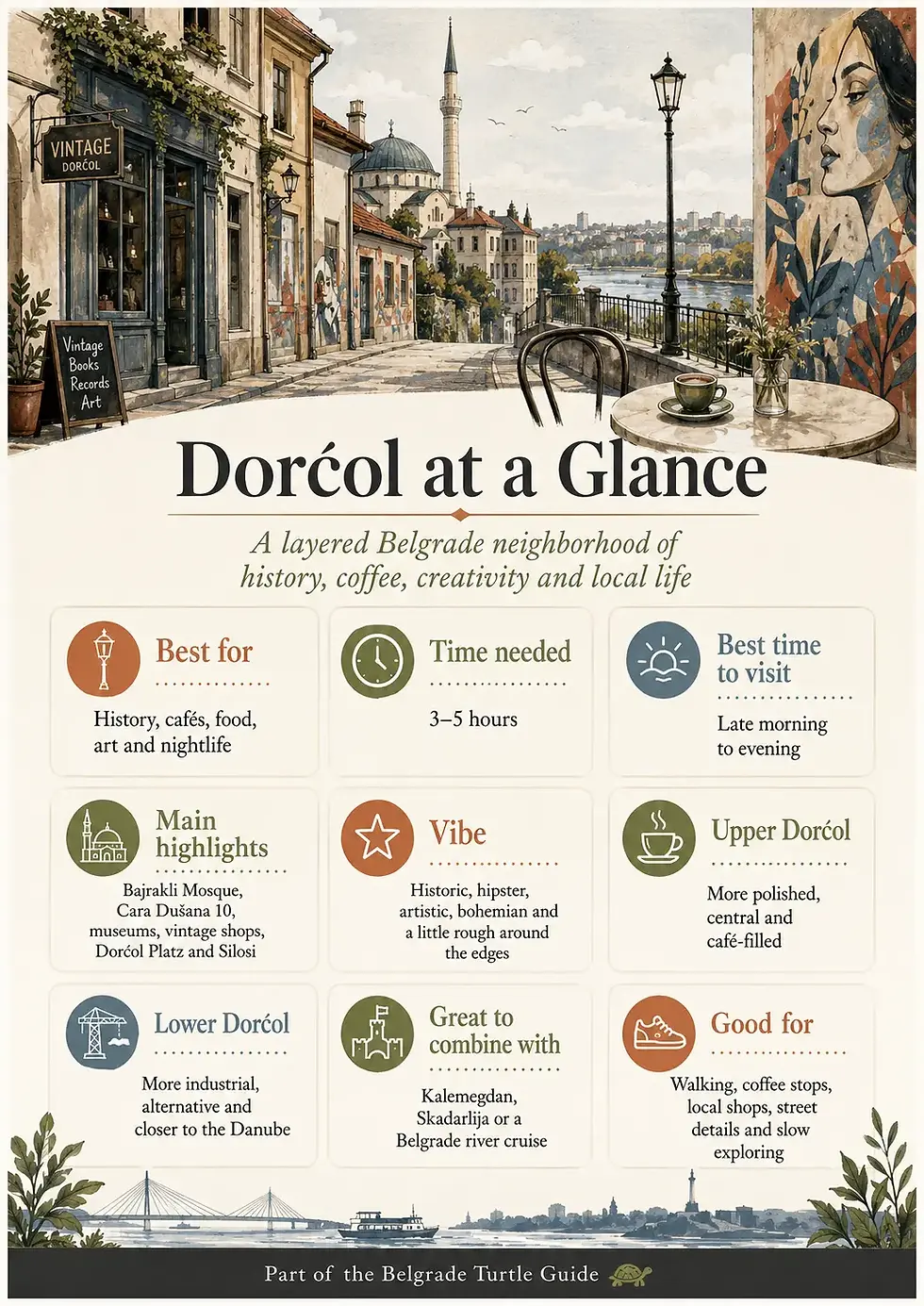
Question | Answer |
Best for | History, food, cafés, art, nightlife and neighbourhood wandering |
Time needed | 3–5 hours |
Best time to visit | Late morning through evening |
Main historic sights | Bajrakli Mosque, Cara Dušana 10 and Dorćol’s museums |
Best for coffee | Upper and central Dorćol |
Best for alternative culture | Lower Dorćol, Dorćol Platz and Silosi |
Best nearby attraction | Kalemegdan and Belgrade Fortress |
Best finishing point | The Danube, dinner, nightlife or a river cruise |
Walking difficulty | Generally easy, although some pavements are uneven |
Ideal for | Travellers who prefer neighbourhoods to checklist sightseeing |
Is Dorćol Worth Visiting?
Yes. Dorćol is worth visiting if you want to experience Belgrade beyond its most obvious landmarks.
It is particularly rewarding for travellers who enjoy:
neighbourhoods with a strong local identity;
historic buildings mixed with ordinary city life;
independent shops and creative businesses;
cafés, restaurants and bars;
street art and visual details;
small museums;
architecture from several different periods;
places that reveal their character gradually.
Dorćol is not beautiful in a consistent, carefully preserved way.
Some streets contain elegant historic houses and fashionable restaurants. Others are dominated by socialist apartment blocks, workshops, parked cars or neglected façades. The lower part of the neighbourhood becomes more industrial as it approaches the Danube.
That inconsistency is not something to overlook. It is part of the story.
Dorćol contains traces of Ottoman Belgrade, the former Jewish quarter, 19th-century merchant life, Yugoslav urban development, industrial expansion and contemporary gentrification. Instead of replacing one another completely, these layers remain visible side by side.
Where Is Dorćol?
Dorćol occupies part of Belgrade’s historic municipality of Stari Grad.
It lies below and east of the central pedestrian areas around Knez Mihailova and Republic Square, extending toward the Danube. Kalemegdan borders it on one side, while Skadarlija and the city centre sit close to its upper streets.
Dorćol is easy to reach on foot from:
Republic Square;
Knez Mihailova;
Studentski Trg;
Kalemegdan;
Skadarlija;
the Botanical Garden.
However, Dorćol does not have one universally agreed boundary. Visitors and locals sometimes use the name loosely, especially when discussing restaurants, nightlife and nearby streets.
The most useful distinction is between Upper Dorćol and Lower Dorćol.
Upper Dorćol vs Lower Dorćol

Dorćol changes noticeably as you move downhill toward the Danube.
Upper Dorćol is closer to the historic centre, Studentski Trg, Knez Mihailova and Kalemegdan. Lower Dorćol stretches toward the river, port and former industrial areas.
The division is not an official administrative border. It is more about geography, atmosphere and local identity.
Upper Dorćol | Lower Dorćol |
Closer to the city centre | Closer to the Danube |
More polished and visibly affluent | Rougher and more post-industrial |
Restaurants, cafés and bars | Warehouses, workshops and creative spaces |
Historic houses mixed with newer luxury properties | Socialist buildings and industrial remnants |
Busier and more curated | Quieter, alternative and uneven |
Easier to combine with Kalemegdan | Easier to combine with Silosi and the river |
Upper Dorćol is where the neighbourhood’s fashionable and affluent side is most visible.
You will find specialty coffee, stylish restaurants, restored buildings, expensive apartments, concept stores and people who appear to have dressed very carefully to look as though they did not try at all.
Lower Dorćol feels less finished.
Its streets contain older residential buildings, socialist-era housing, workshops, warehouses, murals and traces of industrial Belgrade. Some parts feel almost forgotten; others have been adopted by artists, event organisers and new businesses.
Neither side is the “real” Dorćol. The neighbourhood’s character comes from the relationship between them.
The football divide
Dorćol’s upper and lower identities are also sometimes explained through football.
In local neighbourhood lore, Upper Dorćol is more strongly associated with Partizan, while Lower Dorćol is connected with Crvena zvezda, or Red Star.
This is not an official boundary, and football loyalties are never perfectly contained by a few streets. Still, the distinction matters because club identity in Belgrade is expressed visually and socially.
Look closely and you may notice:
club colours;
graffiti;
stickers;
murals;
initials and symbols;
references painted onto walls and electrical boxes.
To an unfamiliar visitor, they may look like random markings. To locals, they can reveal territory, community and decades of rivalry.
A Short History of Dorćol
Dorćol is one of the oldest continuously inhabited parts of Belgrade outside the fortress.
Its name is commonly connected to the Turkish expression dört yol, meaning “four roads.” The name reflects the area’s history as an important crossing point during Ottoman rule. Your existing Dorćol restaurant guide also introduces this origin and the neighbourhood’s long association with trade, movement and different communities.
Its position near the fortress, markets, roads and Danube made Dorćol a natural place for merchants, craftspeople, travellers and religious communities to settle.
Over time, the neighbourhood became home to:
Muslim communities;
Sephardic Jewish families;
Orthodox Christians;
merchants from different parts of the Ottoman and Habsburg worlds;
craftspeople and traders;
later industrial and working-class communities.
Dorćol was repeatedly damaged, rebuilt and transformed as Belgrade changed rulers and expanded.
This explains why its history does not appear as one neat architectural ensemble. An Ottoman-era landmark may stand near a 19th-century house, a Yugoslav apartment building and a contemporary café.
Dorćol is less like a preserved historic district and more like an archaeological cross-section of Belgrade that people still live inside.

1. Visit Bajrakli Mosque
Bajrakli Mosque is one of Dorćol’s most important historic landmarks and the only surviving mosque from the many that once existed in Ottoman Belgrade.
It stands on Gospodar Jevremova Street, surrounded by the ordinary life of the neighbourhood. Its setting is part of what makes it so striking. There is no large ceremonial square separating it from the city. The mosque remains embedded in the street.
The building is also an active religious space, not merely a sightseeing attraction.
Visitors should:
dress respectfully;
avoid entering during prayer unless invited;
speak quietly;
ask before taking photographs of people;
remember that worship takes priority over tourism.
Bajrakli Mosque is a useful starting point for understanding Dorćol because it reveals how much of the neighbourhood’s Ottoman past has disappeared.
Its survival is exceptional. Its surroundings require imagination.
A future walk through Ottoman Dorćol can build from here, tracing street names, former commercial routes and the few physical remains still visible today.
2. Discover Dorćol’s Jewish Heritage
Dorćol was historically the centre of Jewish life in Belgrade, particularly for the city’s Sephardic community.
Jewish families lived, worked and worshipped in the area for centuries. The community contributed to Dorćol’s commercial, cultural and everyday life, helping shape the neighbourhood’s identity as a place where languages, traditions and trading networks met.
Much of that physical world was destroyed or altered during the 20th century, particularly during the Holocaust.
Today, understanding Jewish Dorćol requires looking beyond what remains immediately visible.
Relevant places include:
the Jewish Historical Museum;
the Belgrade Synagogue;
streets associated with the former Jewish quarter;
memorials and surviving community institutions;
locations where important buildings once stood.
The Jewish Historical Museum is particularly valuable for visitors who want context extending beyond Belgrade. Its collection explores Jewish life across the territory of the former Yugoslavia, including religious traditions, family life, migration, persecution and survival.
This history should not be presented only as a story of disappearance.
Belgrade still has an active Jewish community, and Jewish Dorćol is part of both the neighbourhood’s past and its continuing identity.
3. See One of Belgrade’s Oldest Houses
At Cara Dušana 10 stands one of Belgrade’s oldest surviving residential buildings.
It is easy to miss.
The house does not occupy a grand square, and it may not immediately appear as monumental as Belgrade Fortress, the Church of Saint Sava or the city’s palaces. It sits within an ordinary street surrounded by the traffic, shops and residential life of modern Dorćol.
That ordinariness is what makes it important.
The building offers a rare glimpse of the city before many of its later transformations. It reminds visitors that some of Belgrade’s oldest history survives not only in museums and fortifications but within the everyday neighbourhood.
Your existing afternoon itinerary already presents Cara Dušana 10 as an example of major history hiding in plain sight, making that article the natural companion for visitors who want to follow the wider route.
4. Visit Dorćol’s Museums
Dorćol has several smaller museums that can be combined with a neighbourhood walk.
They do not require an entire day, making them useful for visitors who want cultural context without spending hours inside one major institution.
Museum | Best for | Suggested time |
Museum of Vuk and Dositej | Serbian language, education and national culture | 45–60 minutes |
Jewish Historical Museum | Jewish heritage in Belgrade and former Yugoslavia | 45–60 minutes |
Museum of Science and Technology | Technology, transport, industry and families | 1–2 hours |
Retro video-game collection or museum | Interactive nostalgia and rainy days | 60–90 minutes |
Museum of Vuk and Dositej
This museum is dedicated to two central figures in Serbian education, language and culture: Dositej Obradović and Vuk Karadžić.
It is housed in one of the neighbourhood’s most historically atmospheric buildings and works especially well as part of a route through Upper Dorćol.
Jewish Historical Museum
The museum offers context for understanding Jewish life in Belgrade and across the former Yugoslavia.
It is an essential stop for visitors exploring Dorćol’s multicultural history.
Museum of Science and Technology
This is one of the best Dorćol attractions for families, curious adults and rainy days.
Its exhibitions cover scientific development, machinery, transport, technology and industrial life. It also connects naturally with Lower Dorćol’s industrial character.
Before visiting any museum, check its current opening days and hours. Smaller institutions may close on Mondays, holidays or during exhibition changes.
5. Notice Dorćol’s Architecture
Dorćol’s architecture is not defined by one style.
That is precisely what makes it interesting.
While walking through the neighbourhood, you may encounter:
Ottoman-era remains;
modest 18th- and 19th-century houses;
merchant residences;
interwar villas and apartment buildings;
socialist residential blocks;
industrial structures;
contemporary luxury developments;
renovated façades beside buildings in visible decline.
Dorćol’s historic homes often reveal themselves through smaller details rather than dramatic scale:
arched entrances;
hidden courtyards;
decorative gates;
floral motifs;
unusual rooflines;
corner façades;
old workshop and storefront arrangements.
The neighbourhood also contains buildings connected to important architects, artists and political figures.
Among the stories worth exploring are those of Jelisaveta Načić, Serbia’s first female architect, and artists Beta and Rista Vukanović, whose former home reflects the artistic life of early-20th-century Belgrade.
Do not approach Dorćol expecting a perfectly restored Central European old town.
Its appeal lies in the interruption: a beautiful historic building followed by a grey apartment block, followed by a contemporary design store, followed by an empty plot or faded industrial wall.
6. Look for Dorćol’s Socialist Layer
Visitors often hear about Ottoman Dorćol, Jewish Dorćol and bohemian Dorćol.
The Yugoslav layer receives less attention, even though it remains visible throughout the neighbourhood.
After the Second World War, Belgrade expanded and modernised under socialist Yugoslavia. Dorćol changed with it.
Older buildings were replaced or surrounded by:
apartment blocks;
public housing;
schools and community buildings;
industrial facilities;
workshops;
shared courtyards;
practical urban infrastructure.
Some of these additions are architecturally significant. Others are simply ordinary remnants of the city in which generations of residents grew up.
Today, socialist Dorćol often appears in fragments:
a tiled entrance hall;
an old sign above a shop;
heavy concrete balconies;
a neighbourhood business that seems unchanged for decades;
a communal courtyard;
ageing playground equipment;
a block of flats interrupting a row of older houses.
These details keep Dorćol from becoming a fully curated lifestyle district.
The fashionable neighbourhood exists, but Yugoslav Dorćol remains underneath it.
7. Browse Vintage Stores and Independent Shops
Dorćol’s vintage stores, local designers and small businesses fit naturally into the neighbourhood’s atmosphere.
Shopping here does not necessarily feel like entering a formal retail district.
Independent stores are often scattered among residential buildings, cafés, workshops and older shops.
Depending on what is currently open, you may find:
vintage and second-hand clothing;
locally designed jewellery;
ceramics;
illustrations and prints;
handmade accessories;
records;
books;
small fashion labels;
home décor;
Serbian-made gifts;
artist-run projects.
Dorćol is particularly suited to vintage shopping because the clothes and objects feel at home among its old façades, Yugoslav remnants and contemporary creative culture.
The neighbourhood’s best independent shops often feel personal and slightly eccentric. They reflect the taste of the person behind the business rather than a broader chain identity.
Because small shops can move, change their hours or operate irregularly, check current information before building your entire visit around one store.
Better still, allow time to wander. Some of Dorćol’s most interesting businesses are the ones you encounter accidentally.
8. Look for Murals and Football Symbols
Street art is part of Dorćol’s visual language.
Some murals are large and intentional. Others are layered with tags, stickers, political references, football identities and neighbourhood messages.
The most interesting approach is not simply to search for a list of famous murals. Pay attention to how the surfaces of Dorćol change as you walk downhill.
Upper Dorćol tends to feel more polished, although street art still appears in courtyards and side streets.
Lower Dorćol offers:
larger industrial walls;
rougher surfaces;
football graffiti;
political messages;
spontaneous interventions;
commissioned murals;
layers of older work underneath newer paint.
Some pieces are decorative. Others carry meanings that may not be obvious to visitors.
Football symbols are especially important. The rivalry between Partizan and Crvena zvezda is not confined to stadiums. It appears throughout Belgrade in neighbourhood territories, visual codes and social identities.
Treat this urban language with curiosity, but avoid altering, posing provocatively with or making light of symbols you do not understand.
9. Check What Is Happening at Dorćol Platz
Dorćol Platz reflects the neighbourhood’s creative, social and slightly improvised character.
It is not one fixed type of venue. Depending on its current programme, it can function as:
a concert space;
a night-out destination;
a theatre or performance venue;
a design market;
a bazaar;
a location for food events;
a place to discover local makers and independent sellers;
a gathering point for creative and community projects.
This flexibility is exactly why it belongs in a Dorćol guide.
One visit may involve live music and drinks. Another may centre on a daytime market where local designers, vintage sellers, artists and small businesses present their work.
Check the current programme before visiting. Dorćol Platz is most rewarding when you choose an event that matches your interests rather than treating the space as a conventional attraction with the same experience every day.
10. Stop for Coffee
Coffee is not a minor part of Dorćol life. It is one of the ways the neighbourhood is experienced.
Dorćol has enough variety to accommodate almost every coffee mood:
specialty coffee;
brunch;
laptop-friendly cafés;
garden seating;
quick espresso;
people-watching;
a slow break between museums;
coffee before continuing toward the river.
The café scene also expresses the neighbourhood’s contemporary identity.
Some places are minimalist and design-conscious. Others feel warm, crowded and conversational. A few occupy old houses or hidden gardens, creating the illusion that you have stepped temporarily outside central Belgrade.
Rather than trying to visit the “best” café according to a universal ranking, choose based on what you need at that moment.
Are you looking for excellent coffee, breakfast, a quiet corner, outdoor seating or somewhere close to the next stop?
Our dedicated guide to the best cafés in Dorćol organises recommendations by mood and purpose, including brunch, remote work, dates, sightseeing breaks and stops before a river cruise.
11. Eat in Dorćol
Dorćol is one of the easiest areas in Belgrade around which to build an entire day of food and sightseeing.
Within the wider neighbourhood, you can find:
traditional Serbian food;
ćevapi and casual local grill;
vegan and plant-based meals;
Japanese food;
Italian and Mediterranean restaurants;
brunch;
bakeries;
romantic garden restaurants;
polished dining;
dramatic rooftop experiences;
old-school Belgrade institutions.
That variety reflects Dorćol itself.
You can eat somewhere deeply traditional, somewhere aggressively contemporary or somewhere that combines old architecture with an international menu.
For a first visit, decide what role the meal should play in your day:
For a quick local meal
Choose a bakery, grill or casual restaurant that allows you to continue sightseeing without losing two hours.
For a slow afternoon
Look for a garden, terrace or relaxed restaurant where the atmosphere becomes part of the visit.
For a romantic evening
Dorćol has intimate restaurants, hidden gardens and polished dining options that work well after a walk or river cruise.
For traditional Serbian food
Choose a restaurant that focuses on local dishes and old-Belgrade atmosphere rather than an international menu.
Our complete Dorćol restaurant guide compares options by cuisine, mood, budget and suitability before or after a cruise. It already covers Serbian food, vegan choices, brunch, casual meals and more formal dinners, so use it for specific recommendations rather than treating this pillar as another restaurant list.
12. Experience Dorćol After Dark
Dorćol changes after sunset, but it does not become one single nightlife district.
Its evening options are spread across different streets and atmospheres.
You can find:
relaxed neighbourhood bars;
cocktail bars;
wine;
live music;
alternative venues;
crowded social spaces;
outdoor summer events;
bars around Cetinjska;
venues in and around Cvijićeva;
industrial and riverside events;
late-night food.
Dorćol nightlife is best approached by mood rather than by trying to visit every famous venue.
Some evenings call for a quiet drink in an intimate bar. Others lead toward music, a courtyard full of people or an event at Dorćol Platz or Silosi.
The neighbourhood’s bohemian character is not identical to Skadarlija’s traditional image of kafanas and live folk music.
Dorćol’s version is more contemporary and less formal. It includes artists, musicians, designers, local regulars, students, expats, professionals and people who have been sitting at the same neighbourhood table since before the fashionable bars appeared.
Our dedicated Dorćol nightlife guide organises places according to atmosphere, including relaxed drinks, live music, alternative venues and later nights out.
13. Explore Industrial Lower Dorćol
As you move toward the Danube, Dorćol becomes less visibly historic and more industrial.
This part of the neighbourhood was shaped by:
the Port of Belgrade;
warehouses;
workshops;
transport infrastructure;
industrial facilities;
the river economy;
later creative reuse.
Lower Dorćol is not the polished waterfront many visitors expect from a European capital.
Parts of it remain difficult to navigate, neglected or cut off from the river by infrastructure. Yet this is what makes it revealing.
It shows that Belgrade’s relationship with the Danube has never been only scenic. The river has also been a place of work, transport, trade and industry.
In recent years, some former industrial spaces have been reused for art, events, nightlife and cultural projects. This has introduced a new creative identity without completely erasing the older one.
14. Visit Silosi and the Danube Side
Silosi has become one of the best-known symbols of Lower Dorćol’s transformation.
The large industrial structures create a dramatic backdrop for exhibitions, events, performances, food, drinks and riverside gatherings.
The experience depends heavily on the season and current programme.
On one visit, Silosi may feel like a relaxed outdoor social space. On another, it may host a cultural event, concert, installation or large gathering.
The setting is as important as the programme.
Here, Dorćol’s industrial past, contemporary creative culture and relationship with the Danube become visible in the same place.
Check current access and events before visiting, especially outside the warmer months.
15. Walk From Dorćol to the Danube
The walk from Upper Dorćol toward the Danube is one of the best ways to understand the neighbourhood.
It takes you through several versions of Belgrade:
the historic streets near Studentski Trg;
Ottoman and Jewish heritage;
old residential buildings;
cafés, restaurants and independent shops;
socialist housing;
workshops and industrial structures;
the port and riverfront.
The transition is gradual rather than theatrical.
You may not always feel that you are approaching one of Europe’s major rivers. Streets, railway infrastructure and industrial sites sometimes interrupt the connection.
Then the city opens and the Danube appears.
That uneven journey tells a more interesting story than a perfectly landscaped promenade would.
A Self-Guided Dorćol Walking Route
For a balanced first visit, follow this route:

Stop 1: Studentski Trg
Begin near the edge of Dorćol and orient yourself before moving into the historic streets.
Stop 2: Museum of Vuk and Dositej
Visit the museum or observe the historic building and surrounding streets.
Stop 3: Bajrakli Mosque
Continue through Gospodar Jevremova and pause at one of the most important surviving landmarks of Ottoman Belgrade.
Stop 4: Jewish heritage
Visit the Jewish Historical Museum or explore the streets associated with the historic Jewish quarter.
Stop 5: Cara Dušana 10
See one of Belgrade’s oldest surviving residential houses.
Stop 6: Coffee or lunch
Pause at a Dorćol café, bakery or restaurant.
Stop 7: Church of Saint Alexander Nevsky
Continue through the residential streets and visit this distinctive neighbourhood church.
Stop 8: Museum of Science and Technology
Choose the museum if you want an indoor cultural stop, particularly with children or during poor weather.
Stop 9: Dorćol Platz
Check whether a market, event, performance or evening programme is taking place.
Stop 10: Lower Dorćol and Silosi
Continue toward the industrial area and the Danube.
Optional final stop: Belgrade river cruise
Finish at the river and experience the city from the water.
From a boat, you can understand how Dorćol relates to Kalemegdan, the Port of Belgrade, Great War Island, New Belgrade and the Sava–Danube confluence.
Suggested Dorćol Itineraries
Dorćol in Two Hours
This route works when you have limited time:
Start at Studentski Trg.
Walk to the Museum of Vuk and Dositej.
Visit Bajrakli Mosque.
See Cara Dušana 10.
Stop for coffee.
Finish near Kalemegdan or Skadarlija.
This route focuses on Upper Dorćol and the neighbourhood’s historic layer.
Half a Day in Dorćol
Allow three to five hours:
Explore the historic streets.
Visit Bajrakli Mosque.
Choose one museum.
See Cara Dušana 10.
Stop for coffee or lunch.
Browse vintage stores and small businesses.
Walk toward Dorćol Platz or Lower Dorćol.
Finish at Silosi or the Danube.
Dorćol From Afternoon to Evening
This is the best way to experience the neighbourhood’s full personality:
Begin with a museum or historic walk.
Stop at an independent shop or café.
Continue through Lower Dorćol.
Visit Silosi or walk toward the river.
Watch sunset from the water.
Return for dinner, drinks or an event at Dorćol Platz.
Our existing guide to spending an afternoon in Dorćol provides a more detailed history-focused route that can be followed before a cruise.
A Creative Dorćol Day
For art, vintage and local businesses:
Begin with coffee in Upper Dorćol.
Browse independent stores and vintage clothing.
Look for murals and artist spaces.
Check the programme at Dorćol Platz.
Continue toward Silosi.
Stay for an event, drinks or music.
A Food and Nightlife Route
For a slower social day:
Begin with brunch or coffee.
Walk through the old neighbourhood.
Stop for a casual afternoon drink.
Have dinner in Dorćol.
Continue to a bar, live-music venue or Dorćol Platz.
Can You Combine Dorćol With Kalemegdan?
Yes. Dorćol and Kalemegdan are very easy to combine.
For a history-focused day, begin at Belgrade Fortress and descend into Dorćol.
For a more relaxed route, explore Dorćol first, stop for lunch or coffee and then continue toward Kalemegdan in the late afternoon.
The two areas offer very different perspectives.
Kalemegdan presents the monumental history of Belgrade: fortifications, battles, empires and views over the confluence.
Dorćol presents the everyday history below it: homes, religious communities, shops, workshops, cafés and streets shaped by ordinary city life.
Can You Combine Dorćol With a River Cruise?
Yes. Dorćol is one of the best neighbourhoods to visit before or after a Belgrade river cruise.
The combination creates a natural progression:
historic streets → coffee or food → industrial Lower Dorćol → the Danube → Belgrade from the water
A river cruise adds the geography that is difficult to understand from the streets alone.
From the water, you can see:
Kalemegdan above the confluence;
the Port of Belgrade;
the Danube side of Dorćol;
Great War Island;
Zemun;
New Belgrade;
the meeting of the Sava and Danube.
This allows the neighbourhood’s history to become part of a wider story about how Belgrade developed around its rivers.
Practical Tips for Visiting Dorćol
How much time do you need in Dorćol?
Allow at least two hours for a short historic walk.
Three to five hours is better if you want to visit a museum, stop for coffee or lunch and explore both Upper and Lower Dorćol.
An entire afternoon and evening works best if you also want dinner, nightlife or a river cruise.
Is Dorćol walkable?
Yes. Dorćol is centrally located and best explored on foot.
However, not every pavement is smooth. Some streets are narrow, uneven or crowded with parked cars.
Comfortable shoes are recommended.
When is the best time to visit Dorćol?
Late morning through evening offers the most complete experience.
Museums and shops are usually daytime activities, while restaurants, bars and cultural spaces become livelier later.
For markets, museums or specific independent shops, check current opening hours.
Is Dorćol suitable for children?
Yes, particularly if your route includes the Museum of Science and Technology, Kalemegdan, casual cafés and a shorter walk.
Lower Dorćol may be less convenient with very young children because of uneven pavements, traffic and industrial infrastructure.
Is Dorćol accessible for visitors with limited mobility?
Some parts are relatively flat, but accessibility varies significantly.
Uneven pavements, steps, older entrances and parked vehicles can create difficulties.
Contact individual museums, restaurants and venues before visiting if step-free access is essential.
Is Dorćol safe?
Dorćol is generally a busy central neighbourhood used by residents and visitors throughout the day and evening.
Standard city precautions still apply. Pay attention to belongings in crowded places, use well-lit routes late at night and avoid entering abandoned industrial buildings or restricted port areas.
Is Dorćol a good place to stay?
Yes, particularly for travellers who want:
central accommodation;
restaurants and cafés nearby;
easy access to Kalemegdan;
nightlife;
a neighbourhood atmosphere;
the ability to explore much of old Belgrade on foot.
The area can be noisy around popular bars and nightlife streets, so check the exact location of accommodation rather than relying only on the “Dorćol” label.
Explore Dorćol in Depth
This guide is the starting point for our wider Dorćol collection.
Food and coffee
Nightlife and itineraries
Future Dorćol guides
A Short History of Dorćol
Upper Dorćol vs Lower Dorćol
A Self-Guided Dorćol Walking Route
Dorćol Street Art Guide
Local Artists, Galleries and Creative Spaces in Dorćol
The Best Vintage and Independent Shops in Dorćol
Jewish Dorćol
Ottoman Dorćol
Industrial Dorćol
Dorćol Museums Guide
Football, Murals and Local Identity in Dorćol
From Lower Dorćol to the Danube
Frequently Asked Questions About Dorćol
What is Dorćol known for?
Dorćol is known for its layered history, restaurants, cafés, nightlife, museums, old houses, street art, independent shops and proximity to Kalemegdan and the Danube.
Is Dorćol worth visiting?
Yes. Dorćol is worth visiting for travellers who enjoy historic neighbourhoods, local food, cafés, art, nightlife and places where ordinary city life exists beside important cultural landmarks.
What does Dorćol mean?
The name Dorćol is commonly associated with the Turkish expression “dört yol,” meaning “four roads.” It refers to the area’s historic role as a crossroads during Ottoman rule.
What is the difference between Upper and Lower Dorćol?
Upper Dorćol is closer to the city centre, Kalemegdan and Studentski Trg. It is generally more polished and contains many cafés, restaurants and historic streets. Lower Dorćol extends toward the Danube and has a rougher, more industrial and alternative character.
How long should you spend in Dorćol?
Two hours is enough for a short historic walk. Three to five hours is better if you want to visit a museum, stop for food and explore Lower Dorćol. An afternoon and evening allows you to include nightlife or a river cruise.
Is Skadarlija part of Dorćol?
Skadarlija sits beside Dorćol and the two areas are easy to combine, although they have different identities. Skadarlija is known primarily as Belgrade’s traditional bohemian quarter, while Dorćol is larger and combines history, residential life, contemporary cafés, restaurants, nightlife and industrial spaces.
Can you walk from Dorćol to Kalemegdan?
Yes. Dorćol borders the wider Kalemegdan area, and many of its upper streets are only a short walk from Belgrade Fortress.
Can you walk from Dorćol to the Danube?
Yes. Dorćol extends downhill toward the Danube. The route becomes more industrial as you approach the river, and some sections are less polished than a conventional promenade.
Is Dorćol good for restaurants and cafés?
Yes. Dorćol is one of the best central Belgrade neighbourhoods for restaurants, brunch and coffee. It offers Serbian food, international restaurants, vegan options, casual meals, specialty coffee and more formal dining.
Is Dorćol good for nightlife?
Yes. Dorćol has neighbourhood bars, cocktail venues, live music, alternative cultural spaces and easy access to nightlife around Cetinjska, Cvijićeva, Dorćol Platz and the industrial riverfront.
Is Dorćol good for vintage shopping?
Yes. Dorćol’s creative culture and independent businesses make it a good area for vintage clothing, local design, handmade products and small concept stores. Because individual shops may move or change their hours, check current information before visiting.
Is Dorćol good for families?
Yes, particularly during the day. Families may enjoy the Museum of Science and Technology, cafés, casual restaurants and nearby Kalemegdan. Choose a shorter route if travelling with small children.
Is Dorćol a good area to stay in Belgrade?
Yes. Dorćol is central, walkable and close to restaurants, nightlife, Kalemegdan and the historic city centre. Visitors sensitive to noise should check whether their accommodation is close to busy bars or nightlife streets.
Final Thoughts: Why Dorćol Belongs on Your Belgrade Itinerary
Dorćol is not Belgrade’s prettiest neighbourhood in the conventional sense.
It is too contradictory for that.
It contains old houses and socialist blocks, family businesses and fashionable restaurants, football graffiti and art spaces, historic religious sites and industrial buildings, elegant residents and lifelong neighbourhood characters.
A perfectly restored version of Dorćol would probably be less interesting.
Its appeal lies in the fact that the layers have not been completely separated. Ottoman, Jewish, bourgeois, Yugoslav, industrial and contemporary Belgrade remain visible in the same neighbourhood.
Come for the historic streets and museums.
Stay for coffee, vintage stores, local businesses, food, murals, music and the slow walk toward the Danube.
Then continue to the river.
From the water, Dorćol becomes part of an even larger story - one that connects the old city, Kalemegdan, the Port of Belgrade, Great War Island, Zemun, New Belgrade, and the meeting of the Sava and Danube.
That is where Belgrade’s many contradictions begin to make sense.



Comments