
Belgrade Fortress and Kalemegdan: Complete Visitor Guide

Belgrade Fortress is the historical core of the Serbian capital and one of the best places to understand why the city exists where it does.
Built on a ridge above the confluence of the Sava and Danube, the fortress has been a Roman military camp, medieval stronghold, Serbian capital, Ottoman border fortress, Habsburg bastion and, eventually, part of Belgrade’s most important public park.
It is not one castle preserved from a single period. It is an enormous landscape of walls, gates, towers, churches, monuments, museums, viewpoints and archaeological remains created, destroyed and rebuilt over many centuries.
The outdoor grounds of Belgrade Fortress and Kalemegdan Park are free to explore. Individual attractions, including the Roman Well, Clock Tower, Military Bunker, Big Gunpowder Magazine, Nebojša Tower and Military Museum, have separate opening hours, tickets or visitor arrangements.
This guide explains what Belgrade Fortress and Kalemegdan actually include, what you should see, how much time you need and how to follow a coherent route without missing the history hidden behind the view.
Belgrade Fortress and Kalemegdan at a Glance
Question | Answer |
Is Belgrade Fortress worth visiting? | Yes. It is Belgrade’s most important historical and geographical landmark |
General outdoor admission | Free |
Paid attractions | Certain towers, museums and underground spaces |
Time needed | 2–3 hours for the essentials; half a day for a deeper visit |
Best time | Morning for history; late afternoon for views and sunset |
Main areas | Kalemegdan Park, Upper Town and Lower Town |
Essential sights | Victor Monument, confluence view, fortress gates, Ružica Church and Lower Town |
Walking conditions | Mixed paths, slopes, cobblestones, stairs and uneven surfaces |
Best first entrance | From Knez Mihailova through Great Kalemegdan |
Best combined with | Dorćol, Kosančićev Venac or a Belgrade river cruise |
Is Kalemegdan the Same as Belgrade Fortress?
Not exactly, although the names are commonly used as though they mean the same place.
Belgrade Fortress is the historical defensive complex. It includes the Upper Town, Lower Town, walls, gates, towers, ditches and structures built during different periods.
Kalemegdan was the open military field in front of the fortress. Its name comes from the Ottoman Turkish words kale, meaning fortress, and meydan, meaning field or open space.
After the fortress lost its military role, this field was gradually transformed into Kalemegdan Park. Landscaping began in 1869, with paths, trees, monuments and public spaces developing during the late nineteenth and early twentieth centuries.
Today, Belgrade Fortress and Kalemegdan Park form one connected cultural and recreational complex. In everyday speech, Belgraders often use “Kalemegdan” for the entire area. That is perfectly normal, but knowing the distinction makes the history much easier to understand.
Why Was Belgrade Fortress Built Here?
The position is the key to the entire story.
Belgrade Fortress stands above the point where the Sava flows into the Danube. From the ridge, defenders could observe vessels, roads, approaching armies and movement across the flat land beyond the rivers.
The site offered several strategic advantages:
steep slopes protected parts of the settlement;
two major rivers formed natural barriers and transport routes;
the confluence connected Central Europe, the Balkans and the lower Danube;
the high ground provided long views across the Pannonian Plain;
whoever controlled the ridge could influence movement along both waterways.
The panoramic view that visitors photograph today was once military intelligence.
This position also helps explain why Belgrade was repeatedly attacked, damaged and rebuilt. The fortress did not merely protect an attractive river city. Control of the fortress meant control of one of the region’s most important strategic crossings.
For a closer explanation of the waterways below, read our complete guide to the Sava and Danube rivers in Belgrade.
A Short History of Belgrade Fortress
Belgrade Fortress cannot be assigned to one civilisation. Its surviving form is the result of construction laid over construction.

Before the visible fortress
People settled the wider Belgrade area long before the standing fortifications were built. Archaeological evidence points to prehistoric occupation around the favourable river landscape.
The Celtic Scordisci established a settlement associated with the name Singidun. Later Roman Singidunum developed into an important military and urban centre on the Danube frontier.
This does not mean the walls visitors see today are 7,000 years old. Human occupation of the area, the Roman military camp and the surviving fortress structures belong to different periods and should not be collapsed into one age claim.
Roman Singidunum
The Romans established a fortified military camp occupied by Legio IV Flavia Felix. Its position supported the defence of the Danube frontier and the growth of the settlement around it.
Visitors sometimes expect an obvious Roman fortress inside Kalemegdan. In reality, later medieval, Ottoman and Habsburg construction was laid over the Roman camp. The surviving Roman remains are fragmentary and lie largely beneath younger fortifications and the surrounding city.
Roman stones, inscriptions and archaeological objects can nevertheless be encountered through displays and collections connected with the fortress.
Byzantine and early medieval Belgrade
After the division and decline of Roman power, the settlement changed rulers repeatedly. Byzantine, Avar, Slavic, Bulgarian and Hungarian control formed part of a complicated early medieval history.
Fortifications were repaired, destroyed and reconstructed as the political frontier moved. Later builders reused advantageous terrain and older foundations rather than preserving a neat sequence for future visitors.
Despot Stefan Lazarević and the Serbian capital
Belgrade became the capital of the Serbian state under Despot Stefan Lazarević in 1403/1404.
Contemporary descriptions present a city that had been damaged and neglected. Stefan began a major programme of reconstruction, strengthening the walls and developing the Upper and Lower Towns.
In the Upper Town, he built a specially fortified castle with its own walls, towers, moat and drawbridge. The complex contained a court, chapel, library, treasury and residences. The city grew into an important military, economic, cultural and religious centre.
Most of the palace has disappeared, but Despot’s Gate and Tower help preserve the atmosphere of this medieval layer. They matter because they show that Belgrade Fortress was not only a military installation. It was also a royal and urban centre.
The defence of Belgrade in 1456
After the fall of Constantinople, Sultan Mehmed II turned toward Belgrade. Ottoman forces besieged the fortress in 1456, but the defenders led by John Hunyadi, with the preaching and mobilisation associated with John of Capistrano, held the city.
The victory delayed Ottoman expansion into Central Europe and became one of the most famous events in the fortress’s history.
The noon-bell tradition is often explained only as a celebration of the victory. Pope Callixtus III had ordered bells and prayer while the siege was still underway; news of the victory then became intertwined with the practice. The fuller story is more complicated than the familiar one-sentence legend.
Ottoman conquest in 1521
Belgrade fell to Sultan Suleiman the Magnificent in 1521 and became part of the Ottoman defensive and administrative system.
Ottoman rule left important layers within the fortress, including the fountain of Mehmed Pasha Sokolović and the urban history of the Lower Town. The name Kalemegdan also comes from the Ottoman period.
Belgrade was no longer simply a northern Serbian stronghold. It became a major Ottoman city positioned toward the empire’s Central European frontier.
Habsburg reconstruction and the Baroque fortress
The Habsburg army captured Belgrade in 1688, again in 1717 and once more in 1789, with Ottoman forces retaking it between those occupations.
The most dramatic architectural transformation followed the Habsburg victory of 1717. Engineer Nicolas Doxat de Démoret was entrusted with rebuilding Belgrade as a modern Baroque artillery fortress.
The project reshaped gates, bastions, ditches and approaches. Elements from this period remain essential to the fortress visitors see today, including the Clock Gate and Tower, King Gate, the so-called Roman Well and structures in the Lower Town.
Doxat’s own story ended brutally. After surrendering Niš under controversial circumstances, he was accused of treason and executed in Belgrade in 1738. A year later, the Treaty of Belgrade returned the city to Ottoman rule and required significant Habsburg works to be demolished.
The episode captures a recurring pattern at the fortress: enormous effort was invested in military construction, only for war and diplomacy to demand another transformation.
Serbian uprisings and the end of Ottoman military control
During the First Serbian Uprising, Karađorđe’s forces entered Belgrade in 1806.
Karađorđe’s Gate preserves the memory of that event; after the Ottomans retook the city, the gate was sealed and the connecting bridge destroyed.
Serbian autonomy developed during the nineteenth century, but Ottoman troops remained in several fortresses. In 1867, the fortress keys were formally transferred to Prince Mihailo Obrenović and the Ottoman military presence ended.
Belgrade Fortress was no longer needed as an active border stronghold. That political change made its transformation into historical space and public park possible.
How Kalemegdan became a park
Landscaping of the former military field began in 1869. Paths were laid, trees planted and monuments gradually introduced.
Work on Great Kalemegdan continued into the early twentieth century, while Little Kalemegdan developed around the area extending toward today’s Art Pavilion and Belgrade Zoo.
The result was a profound change in meaning. Ground once kept open for defence became a place for walking, meeting, art, play, remembrance and views over the rivers.
That contrast remains part of Kalemegdan’s character. It is simultaneously Belgrade’s most important historical complex and one of its most ordinary everyday public spaces.
How Belgrade Fortress Is Organised
The complex becomes easier to explore once you understand its three main visitor zones.
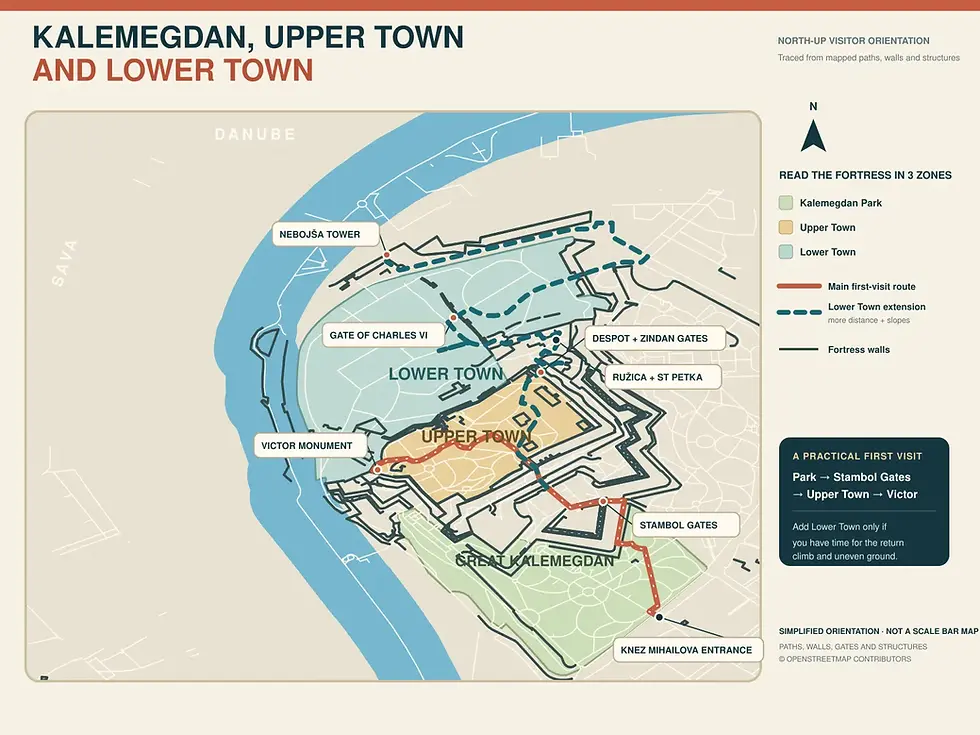
Great and Little Kalemegdan
Kalemegdan Park forms the green approach around the historical fortifications.
Great Kalemegdan lies between Knez Mihailova and the main Upper Town entrances. Its broad paths, monuments and trees make it the natural starting point for most first-time visitors.
Little Kalemegdan extends toward the Cvijeta Zuzorić Art Pavilion and Belgrade Zoo. It feels more like a city park and cultural area than a defensive complex.
Upper Town
The Upper Town contains the most visited monuments, gates and viewpoints.
This is where you will find the Victor Monument, the confluence panorama, the main eighteenth-century gates, the Roman Well area, Military Museum surroundings, Mehmed Pasha Sokolović Fountain and the medieval Despot’s Gate complex.
If you have only one or two hours, prioritise the Upper Town.
Lower Town
The Lower Town occupies the area below the main ridge, closer to the Sava and Danube.
It contains Ružica Church, Saint Petka Chapel, Gate of Charles VI, the Big Gunpowder Magazine, medieval remains, the former hamam and planetarium, and Nebojša Tower farther toward the river.
Many visitors leave after seeing the Victor and Upper Town. The Lower Town is where the fortress begins to feel less like a viewpoint and more like the remains of an inhabited and defended city.
It also involves more distance, slopes and climbing, so it should be treated as an extension rather than casually added to a rushed visit.
Best Things to See at Belgrade Fortress and Kalemegdan

1. The Victor Monument
The Victor, Pobednik in Serbian, is the best-known symbol of Belgrade.
Sculptor Ivan Meštrović created the figure before the First World War as part of a larger monument celebrating Serbia’s victories in the Balkan Wars. The original plan placed it at Terazije, but war, financial difficulties and debate over the monument delayed the project.
The final monument was unveiled at Belgrade Fortress in 1928, marking ten years since the breakthrough of the Salonica Front. The bronze figure stands on a tall column above the rivers, holding a sword and falcon.
Popular retellings often reduce the change of location to scandal over the nude male figure. Public discomfort formed part of the discussion, but the full history also involves war, unfinished plans, money and a long debate over where and how the work should appear.
The monument underwent major conservation and was returned to its pedestal in 2020.
What makes the Victor so effective is not only the statue. Its position turns the figure into a landmark visible from the rivers and the flat land beyond them.
2. The Sava–Danube confluence viewpoint
The space around the Victor offers the classic panorama of Belgrade’s river geography.
From here, you can identify:
the Sava flowing into the Danube;
Great War Island at the confluence;
New Belgrade across the Sava;
Zemun adjoining New Belgrade to the northwest;
the low landscape beyond the Danube;
bridges and the modern Sava skyline.
The view makes the fortress’s strategic importance immediately understandable. It also corrects a common geographical mistake: Zemun and New Belgrade are on the same general side of the rivers and directly meet one another. The settlements across the Danube include Krnjača, Borča and Ovča.
Our Belgrade from the water guide explains how the same cityscape changes when seen from river level.
3. Stambol Gates and the main Upper Town approach
The main approach from Great Kalemegdan passes through a sequence of defensive structures rather than one isolated entrance.
The Outer and Inner Stambol Gates belong to the eighteenth-century system designed to control movement from the land side. Their name points toward the road to Istanbul- Stambol in Ottoman usage.
Passing through the gates helps reveal how a fortress entrance worked: visitors and attackers did not move directly from open ground into the heart of the stronghold.
Bridges, ditches, ravelins, walls and multiple gates slowed and exposed the approach.
4. Clock Gate and Clock Tower
The Clock Gate and Tower stand against the older walls of the Upper Town. They were constructed during the eighteenth-century Austrian occupation.
The octagonal Baroque tower is one of the fortress’s most recognisable vertical landmarks. Its clock gave both the tower and gate their Serbian name, Sahat-kula and Sahat-kapija.
The exterior is easy to include in the main route. Interior access follows the current programme of the fortress administration and should be checked before your visit.
5. Karađorđe’s Gate
Karađorđe’s Gate stands at the western edge of the ravelin and is associated with the First Serbian Uprising.
Karađorđe entered the fortress through this area in 1806. After Ottoman forces returned in 1813, they sealed the gate and destroyed its bridge, partly erasing the route connected with a humiliating loss. The gate was reopened after the Second World War.
It is a small architectural feature with a much larger political story.
6. King Gate
King Gate was built during the Austrian Baroque reconstruction around 1725, on the site of an older medieval entrance.
Its vaulted passage, rooms within the rampart and bridge across the ditch make it one of the best places to see the fortress as an engineered defensive system rather than a collection of picturesque walls.
The route through King Gate also connects the Upper Town with the Sava-facing slope and Roman Well area.
7. The Roman Well-which is not Roman
The Roman Well is one of Kalemegdan’s most persistent myths.
Despite its name, the existing structure was built during the Austrian reconstruction in the first half of the eighteenth century. It was originally known as the Great Well.
Belgraders began calling it Roman in the nineteenth century, when mysterious or forgotten structures were often attributed to the Romans.
The shaft is approximately 60 metres deep and nearly 3.5 metres wide. Two spiral staircases descend around it, creating the dark, theatrical interior responsible for many legends.
Its atmosphere inspired stories of prisoners, hidden passages and unexplained depths. Alfred Hitchcock reportedly admired the location during a visit to Belgrade, but the verified construction history is already interesting without treating every dramatic tale as fact.
The well is a ticketed interior with seasonal visitor arrangements.
8. Military Museum
The Military Museum occupies a prominent section of the Upper Town.
Large artillery pieces, tanks and other exhibits are displayed outdoors, while the indoor permanent collection follows military history from ancient weapons through medieval warfare, Ottoman and Habsburg conflicts, the Serbian uprisings, the Balkan Wars, the world wars and later periods.
The outdoor exhibits can be seen as part of the fortress walk. The indoor museum requires a separate ticket and enough time to visit properly.
Allow at least 60–90 minutes if the collection is one of your priorities. It is better to choose the museum consciously than to rush through it while trying to complete the entire Lower Town route.
9. Mehmed Pasha Sokolović Fountain
The fountain near Defterdar’s Gate is one of the most important surviving Ottoman structures at the fortress.
It was erected in the sixteenth century and is associated with Grand Vizier Mehmed Pasha Sokolović, who was born into a Christian family in the Balkans and rose to the highest levels of Ottoman government.
During the Austrian reconstruction, changes to the surrounding passage left the fountain buried. It was uncovered in 1938 and later restored.
Its relatively modest scale makes it easy to overlook, but that is precisely why it matters: much of Ottoman Belgrade did not survive in an obvious monumental form.
10. Despot’s Gate and Tower
Despot’s Gate and Tower preserve one of the strongest medieval environments in the Upper Town.
They were constructed during the rule of Despot Stefan Lazarević in the early fifteenth century, when this was the principal entrance to the fortress. The massive square tower rose above the Upper Town and helped protect the approach.
The tower is now associated with Belgrade’s public astronomical observatory. Together with nearby Zindan Gate, the complex gives visitors one of the clearest impressions of the medieval fortress.
11. Zindan Gate
Zindan Gate is framed by two round towers and approached across a bridge.
The fifteenth-century complex was designed as a heavily defended entrance. Openings and projecting defensive elements allowed guards to attack enemies directly below the walls.
The word zindan means dungeon. The lower levels of the towers were later used as dark prison spaces, giving the gate its enduring name and grim reputation.
The architecture is documented; many individual tales of prisoners and torture belong to folklore or later retelling and should not automatically be treated as verified history.
12. Ružica Church
Ružica Church occupies a sheltered position beneath Zindan Gate.
The present church was created in 1867 using an eighteenth-century Austrian gunpowder warehouse and initially served as a military church. It was damaged during the First World War and restored afterward.
Its most famous interior details are chandeliers and decorative elements traditionally described as being made from military materials such as shell casings, bullets, bayonets and swords. The symbolism is powerful: objects associated with war were transformed within a religious space.
Ružica remains an active Orthodox church. Visitors should dress and behave respectfully, particularly during services.
13. Saint Petka Chapel
The Chapel of Saint Petka stands below Ružica Church, above a spring long associated with the saint’s cult.
The current chapel is relatively modern but continues a much older pilgrimage tradition. Saint Petka is deeply revered in Serbian Orthodox culture, and the spring water attracts worshippers throughout the year.
This is not simply another tourist interior. It is an active devotional space, and visits should remain quiet and respectful.
14. Gate of Charles VI
The Gate of Charles VI is one of the clearest Baroque features in the Lower Town.
Built after the Habsburg capture of Belgrade in 1717, it had both defensive and ceremonial meaning. Its sculpted and architectural treatment expressed imperial control over a newly conquered strategic city.
The gate is especially useful for comparing the Baroque Habsburg fortress with the nearby medieval and Ottoman layers.
15. Nebojša Tower
Nebojša Tower stands in the Lower Town near the Danube.
Built as a defensive tower in the fifteenth century, it later became an Ottoman prison. Its best-known prisoner was Rigas Feraios, the Greek writer and revolutionary who was killed in 1798 along with his companions.
The restored tower now contains a museum presentation connecting the history of Belgrade, the Ottoman prison and Rigas’s role in Greek and Balkan political thought.
The surviving Lower Town tower should not be confused with the medieval Nebojša Tower described as part of Despot Stefan’s Upper Town castle. The older palace tower did not survive.
Nebojša Tower has separate opening and ticket arrangements and sits considerably farther from the central Upper Town route than it appears on simplified maps.
16. Big Gunpowder Magazine
The Big Gunpowder Magazine was built into the rock during the Austrian occupation of the eighteenth century.
The protected interior stored gunpowder away from direct artillery fire. When open, the halls also contain archaeological material connected with Roman Singidunum.
It is a valuable stop because the building itself represents Habsburg military engineering while the objects inside point back to the Roman settlement buried beneath later Belgrade.
17. The hamam and planetarium
An Ottoman bath in the Lower Town was later adapted for use as a planetarium.
The building’s transformation is characteristic of the fortress: military, religious, civic and cultural functions have repeatedly occupied the same structures.
It is primarily relevant as an external historical feature unless a current astronomical programme is scheduled.
18. Medieval remains in the Lower Town
The Lower Town was once a populated urban area with houses, churches, workshops, streets and religious buildings.
Remains associated with the Metropolitan’s Palace and the medieval settlement are less immediately dramatic than the gates or Victor Monument. However, they help correct the impression that the fortress consisted only of soldiers standing on empty walls.
Belgrade Fortress was a city as well as a stronghold.
Stories and Legends Hidden Inside Kalemegdan
Belgrade Fortress attracts legends because so many of its structures are ruined, buried, renamed or reused. The stories become more interesting when fact and folklore are kept separate.
The Roman Well that became older through its name
The well was built in the eighteenth century, but its nineteenth-century name made it seem ancient. The darkness and twin staircases then encouraged tales of prisoners, secret passages and unexplored depths.
The name is the first layer of the myth.
The engineer executed beside his own fortress
Nicolas Doxat helped transform Belgrade into a modern Habsburg stronghold. His execution after the surrender of Niš turned a military engineer into one of the fortress’s most tragic figures.
His story is not a ghost legend. It shows how closely architecture, military reputation and imperial politics were connected.
The gate an army tried to erase
Karađorđe’s Gate was sealed after Ottoman forces returned to Belgrade. Destroying the bridge and blocking the entrance attempted to remove a physical reminder of the uprising.
Reopening it later restored more than a passage; it restored the political memory attached to it.
The controversy surrounding the Victor
The Victor was not originally designed for its present location. Its long route from a proposed Terazije fountain to the fortress has produced stories about morality, nudity and offended citizens.
Those debates existed, but the final decision also followed war, delay, cost and the collapse of the original project.
Two towers named Nebojša
Medieval accounts describe a Nebojša Tower within Despot Stefan’s Upper Town castle.
The famous surviving Nebojša Tower stands in the Lower Town and was constructed for a different defensive purpose.
The shared name often causes the stories of two buildings to be merged.
Weapons transformed into church decoration
The military chandeliers of Ružica Church are remembered because they reverse the meaning of war materials. Whether every component is identified precisely or not, their symbolic power comes from placing objects of conflict inside a sanctuary.
The Best Walking Route Through Kalemegdan and Belgrade Fortress
The most practical route begins at the end of Knez Mihailova and moves through the park into the Upper Town. The Lower Town should be added only if you have enough time and mobility for the descent and return.

Essential two-hour route
Follow this order:
Enter Great Kalemegdan from Knez Mihailova.
Pass the Monument of Gratitude to France.
Continue beside the outdoor Military Museum exhibits.
Cross the main defensive approach and enter through the Stambol Gates.
See the Clock Gate and Clock Tower.
Walk through the Upper Town toward the Victor Monument.
Stop at the confluence viewpoint and orient yourself toward New Belgrade, Zemun and Great War Island.
Continue toward King Gate and the Roman Well area.
Visit Mehmed Pasha Sokolović Fountain.
Walk toward Despot’s Gate and Tower.
Pass through the Zindan Gate area.
Descend to Ružica Church and Saint Petka Chapel.
This route includes the park, main defensive structures, medieval and Ottoman layers, the essential viewpoint and the two religious sites.
It does not include a full museum visit or the distant end of the Lower Town.
Three- to four-hour historical route
Follow the essential route, then continue through the Lower Town toward:
the Gate of Charles VI;
medieval and archaeological remains;
the Big Gunpowder Magazine, if open;
the former hamam and planetarium;
Nebojša Tower, if open.
The Lower Town extension adds distance and requires either climbing back toward the central fortress or choosing an exit closer to the riverside and Dorćol.
Half-day route with museums
For a deeper visit, combine the historical route with one substantial paid experience:
the Military Museum; or
the Roman Well, Big Gunpowder Magazine and Nebojša Tower, depending on current access.
Trying to explore every paid interior, the full museum and both fortress levels in two hours will turn the visit into a checklist. Choose one area of depth and leave time to look at the landscape.
How Much Time Do You Need at Kalemegdan?
One hour
Walk through Great Kalemegdan, enter the Upper Town, see the Victor Monument and enjoy the confluence view.
This is enough for the essential panorama but not enough to understand the fortress properly.
Two hours
Follow the essential Upper Town route and include Ružica Church and Saint Petka Chapel.
This is the best option for most first-time visitors.
Three to four hours
Explore the Upper and Lower Towns, read the historical interpretation and enter one or two smaller attractions.
Half a day
Add the Military Museum or several paid interiors and allow time for breaks, photography and the longer Lower Town walk.
Belgrade Fortress Tickets and Opening Hours
There is no general ticket for walking through Kalemegdan Park and the open outdoor areas of Belgrade Fortress.
Individual attractions have separate arrangements. These may include:
Roman Well;
Clock Tower;
Military Bunker;
Big Gunpowder Magazine;
Nebojša Tower;
Military Museum;
exhibitions or casemates operating under a current programme.
The official fortress administration currently divides facility hours into two broad periods:
15 April to 15 October: published seasonal hours generally run from 11:00 to 19:00, with last entry at 18:30;
15 October to 15 April: published hours generally run from 10:00 to 17:00, with last entry at 16:30.
During the colder period, visits to some interiors may require arrangement at least 24 hours in advance, a confirmed time and a minimum number of visitors. Nebojša Tower may follow different conditions.
The Military Museum publishes its own schedule and ticket information separately.
Hours, prices, restoration work and access can change. Check the official Belgrade Fortress visitor-information page and the Military Museum visitor page shortly before visiting.
Last checked: August 2026.
When Is the Best Time to Visit Kalemegdan?
Morning
Morning is best for history-focused exploration, quieter paths and more comfortable summer temperatures.
It is also the easiest time for families and visitors who want to photograph gates and monuments without waiting for the busiest afternoon period.
Late afternoon
Late afternoon provides softer light and a natural transition from historical sightseeing to the confluence viewpoint.
It is a good choice if you want to continue toward Dorćol, Kosančićev Venac, dinner or an evening river experience.
Sunset
The Victor viewpoint is one of Belgrade’s classic sunset locations.
Sunset is excellent for atmosphere, silhouettes and river light. It is less useful for entering paid attractions, reading archaeological details or exploring darker interiors, which may close earlier.
After dark
Kalemegdan remains part of central Belgrade’s evening life, particularly around the main paths and Upper Town.
Paid attractions will be closed, and some steps, walls and Lower Town areas can be difficult to navigate in limited light. Stay on clear routes and do not climb onto walls or unprotected historical surfaces.
Where Are the Best Views at Kalemegdan?
Victor Monument viewpoint
The broadest and most recognisable panorama, showing the confluence, Great War Island, New Belgrade and Zemun.
Sava-facing walls
Best for the Sava, New Belgrade, central bridges and the changing city skyline.
Danube-facing side
Best for Great War Island, Zemun and the wider open character of the Danube.
Despot’s Tower area
Best for medieval walls, gates and the internal structure of the Upper Town.
Lower Town
Best for reversing the famous viewpoint: instead of looking down from the fortress, you look back up toward the ridge and understand its height.
For a full interpretation of the islands, districts and skyline visible from the walls, use our guide to Belgrade’s river views.
Accessibility and Walking Conditions
Belgrade Fortress is a large historical landscape rather than one fully accessible museum building.
Surfaces and routes include:
broad paved park paths;
gravel;
cobblestones;
uneven stone;
slopes;
stairways;
bridges across defensive ditches;
narrow, dark or spiral interiors;
a substantial height difference between the Upper and Lower Towns.
Great Kalemegdan and parts of the Upper Town are more manageable than the Lower Town, churches, towers and Roman Well.
Visitors with limited mobility should plan a shorter Upper Town route, allow more time and check access to individual attractions in advance. It would be misleading to describe the entire complex as wheelchair accessible.
The approach from Knez Mihailova is generally the most straightforward for first-time visitors, but historical surfaces remain uneven in places.
Visiting Kalemegdan With Children
Kalemegdan can work well for families because it combines history with open space.
Gates, towers and the outdoor Military Museum displays often make the visit more engaging for children than a conventional indoor museum.
However, parents should consider:
unprotected drops and walls;
uneven stone and steps;
long distances;
limited shade on some exposed parts;
dark interiors that may not suit every child;
the tiring return from the Lower Town.
For younger children, keep the visit to Great Kalemegdan, the main gates, Upper Town and Victor viewpoint.
Belgrade Zoo is beside Little Kalemegdan, but it should be planned as a separate activity rather than squeezed into the same short fortress visit.
What to Wear and Bring
Wear comfortable shoes with stable soles.
Bring water, especially in summer.
Use sun protection on exposed walls and viewpoints.
Carry an extra layer outside summer; wind can be noticeable above the rivers.
Check current facility hours before planning paid interiors.
Bring a charged phone or camera for the views.
Allow more time than an ordinary city-park walk.
Dress respectfully if entering Ružica Church or Saint Petka Chapel.
What to Visit Near Kalemegdan
Knez Mihailova and the city centre
Knez Mihailova is the natural pedestrian approach from Republic Square. It works well before Kalemegdan, while the side streets around it can be explored afterward.
Dorćol
Dorćol begins beside the fortress and is ideal for cafés, food, neighbourhood history and continuing toward the Danube.
Our Dorćol travel guide can help you build the rest of the day around the fortress visit.
Kosančićev Venac
Kosančićev Venac preserves the atmosphere of elevated Old Belgrade above the Sava. Its streets, Cathedral Church area and river views make it a natural continuation from the southern side of Kalemegdan.
Beton Hala and the Sava riverfront
Descending toward Beton Hala brings you below the fortress ridge. Restaurants and the riverside create a strong contrast with the walls and park above.
Belgrade from the water
Kalemegdan explains Belgrade’s geography from above. A river cruise reverses the perspective.

From the water, you can see:
how high the fortress stands above the confluence;
how the Sava enters the Danube below it;
Great War Island between the urban shores;
New Belgrade across the Sava;
Zemun along the Danube;
why this ridge was so difficult to ignore or bypass.
A simple first-time itinerary is to explore the fortress in the afternoon and then see the same geography from river level during golden hour or sunset.
For route types, timing, weather and practical expectations, read our complete guide to Belgrade river cruises.
Suggested Kalemegdan Itineraries
Classic first visit
Knez Mihailova → Great Kalemegdan → main gates → Upper Town → Victor Monument → Ružica Church → Dorćol
Allow two to three hours before continuing into the neighbourhood.
History-focused half-day
Great Kalemegdan → Military Museum exterior → Upper Town gates → Roman Well or Military Museum → medieval gate complex → Lower Town → Nebojša Tower
Check paid-attraction hours before beginning.
Sunset afternoon
Kosančićev Venac → Kalemegdan Park → Upper Town → Victor at golden hour → descend toward the river → sunset cruise
This route shows the historic centre, confluence and fortress from three different perspectives.
Family visit
Great Kalemegdan → outdoor Military Museum exhibits → main gates → Upper Town → Victor viewpoint → short park loop
Keep the Lower Town optional and plan the zoo as a separate visit.
Belgrade Fortress Is the City in One Place
Belgrade Fortress is not the oldest wall, the largest gate or one perfect castle preserved above the rivers.
Its importance comes from accumulation.
Roman military ground lies beneath medieval and later fortifications. A Serbian royal city survives through gates and foundations. Ottoman fountains stand beside Habsburg Baroque defences. A military field became a public park. A monument to victory now overlooks an island protected for nature.
Kalemegdan is where Belgrade’s geography, repeated destruction and constant reinvention become visible.
Walk through it to understand the city from above. Then, if you can, look back at the fortress from the rivers below. The change in perspective completes the story.
Frequently Asked Questions About Belgrade Fortress and Kalemegdan
Is Belgrade Fortress the same as Kalemegdan?
Not exactly. Belgrade Fortress is the historical defensive complex, while Kalemegdan was the open field in front of it and later became a public park. Today the connected area is commonly called Kalemegdan in everyday speech.
Is Belgrade Fortress free to visit?
Yes. Kalemegdan Park and the open outdoor areas of Belgrade Fortress can be explored without a general admission ticket. Individual museums, towers and underground attractions may charge separate admission.
How much time do you need at Kalemegdan?
Allow about two hours for the essential Upper Town route and main viewpoints. Three to four hours is better if you want to explore the Lower Town or enter smaller attractions. A museum-focused visit can take half a day.
What are the best things to see at Belgrade Fortress?
Essential sights include the Victor Monument, Sava–Danube confluence view, Stambol and Clock Gates, Roman Well area, Mehmed Pasha Sokolović Fountain, Despot’s Gate, Zindan Gate, Ružica Church and Saint Petka Chapel. Add the Lower Town and Nebojša Tower when time allows.
What are Belgrade Fortress’s opening hours?
The outdoor park and open fortress grounds do not follow the same ticketed schedule as individual interiors. The Roman Well, Clock Tower, Military Bunker, Big Gunpowder Magazine, Nebojša Tower and museums have separate seasonal hours and arrangements. Check the official visitor page shortly before visiting.
Is the Roman Well at Kalemegdan really Roman?
No. The existing well was built during the Austrian reconstruction of Belgrade Fortress in the first half of the eighteenth century. Belgraders began calling it Roman during the nineteenth century.
Can you enter the towers at Belgrade Fortress?
Some fortress towers and interiors open to visitors under seasonal schedules, guided arrangements or special programmes. Others can only be viewed externally. Check current access rather than assuming every structure is open.
Where is the best sunset view at Kalemegdan?
The plateau around the Victor Monument provides the classic sunset panorama over the Sava–Danube confluence, Great War Island, New Belgrade and Zemun.
Is Kalemegdan suitable for children?
Yes, particularly the park, main gates, outdoor Military Museum exhibits and Upper Town. Children require close supervision around walls, drops, uneven surfaces and stairs. The full Lower Town route may be tiring for younger children.
Is Belgrade Fortress wheelchair accessible?
Only partially. Some park and Upper Town paths are relatively manageable, but cobblestones, slopes, stairs, defensive ditches and narrow historical interiors make many areas difficult or inaccessible. Plan a reduced route and check individual attractions in advance.
Can you walk from Knez Mihailova to Kalemegdan?
Yes. Knez Mihailova leads directly toward Great Kalemegdan and is the simplest approach from Republic Square and central Belgrade.
Can you walk from Kalemegdan to the river?
Yes, but the fortress stands well above the rivers. Routes toward Beton Hala, Dorćol and the Lower Town involve slopes, steps or longer paths, and the return climb should be included in your plan.
What rivers can you see from Belgrade Fortress?
You can see the Sava and Danube. The Sava flows into the Danube below the fortress, beside Great War Island and Ušće.
Is Kalemegdan safe to visit at night?
The main park and Upper Town paths remain part of central Belgrade’s evening life, but paid attractions are closed and darker stairs, walls and Lower Town areas are harder to navigate. Stay on clear paths and avoid climbing on historical structures.
Can you combine Kalemegdan with a river cruise?
Yes. Kalemegdan shows the confluence and surrounding districts from above, while a river cruise reveals the height of the fortress and the same geography from water level. Combining the two gives a clearer understanding of Belgrade.


Comments