
The Best Zemun Walking Route: Gardoš, Old Town and the Danube

The best first-time walk through Zemun begins on Glavna Street, crosses the old civic and merchant centre, climbs through the streets of Gardoš and descends to the Danube. It connects the places that explain Zemun best without sending you back and forth across the neighbourhood.
Allow around three hours for the core route. You can walk it more quickly, but that leaves little time for Gardoš Tower, architectural details, photographs or a pause beside the river.
With the tower, a market visit and lunch on the quay, it becomes an easy half-day in Zemun.
The route is compact, but it is not entirely level. The historic centre and promenade are comparatively flat; Gardoš introduces slopes, cobbles, uneven surfaces and, on the most direct approach, stairs. A step-light alternative is included below.
This guide owns the practical walking order. For a broader choice of attractions, food and visit-planning advice, begin with our complete guide to the best things to do in Zemun.
Zemun walking route at a glance
Route detail | What to expect |
Route type | Compact, mostly circular route with a different ascent and descent |
Recommended start | Zemun Post Office, Glavna 8 |
Recommended finish | Zemun Market and the central quay |
Core stops | 10 numbered stops |
Walking time | Approximately 75–100 minutes without visits or long pauses |
Comfortable visit | Around 3 hours |
Half-day version | 4–5 hours with the tower, lunch and a longer quay walk |
Terrain | Pavement and pedestrian streets, followed by slopes, cobbles and optional stairs around Gardoš |
Cost | The outdoor route is free; tower admission and refreshments are separate |
Best time | Morning for the market; later afternoon for softer river light |
Accessibility | The complete route is not step-free; use the alternative Gardoš approach or omit the hill |
Route summary: Zemun Post Office → Glavna Street → Magistratski Trg → Gospodska Street and Veliki Trg → Old Customs House → Karamata House and Nikolajevska Church → Gardoš Tower → Danube promenade → Old Captaincy → Zemun Market.
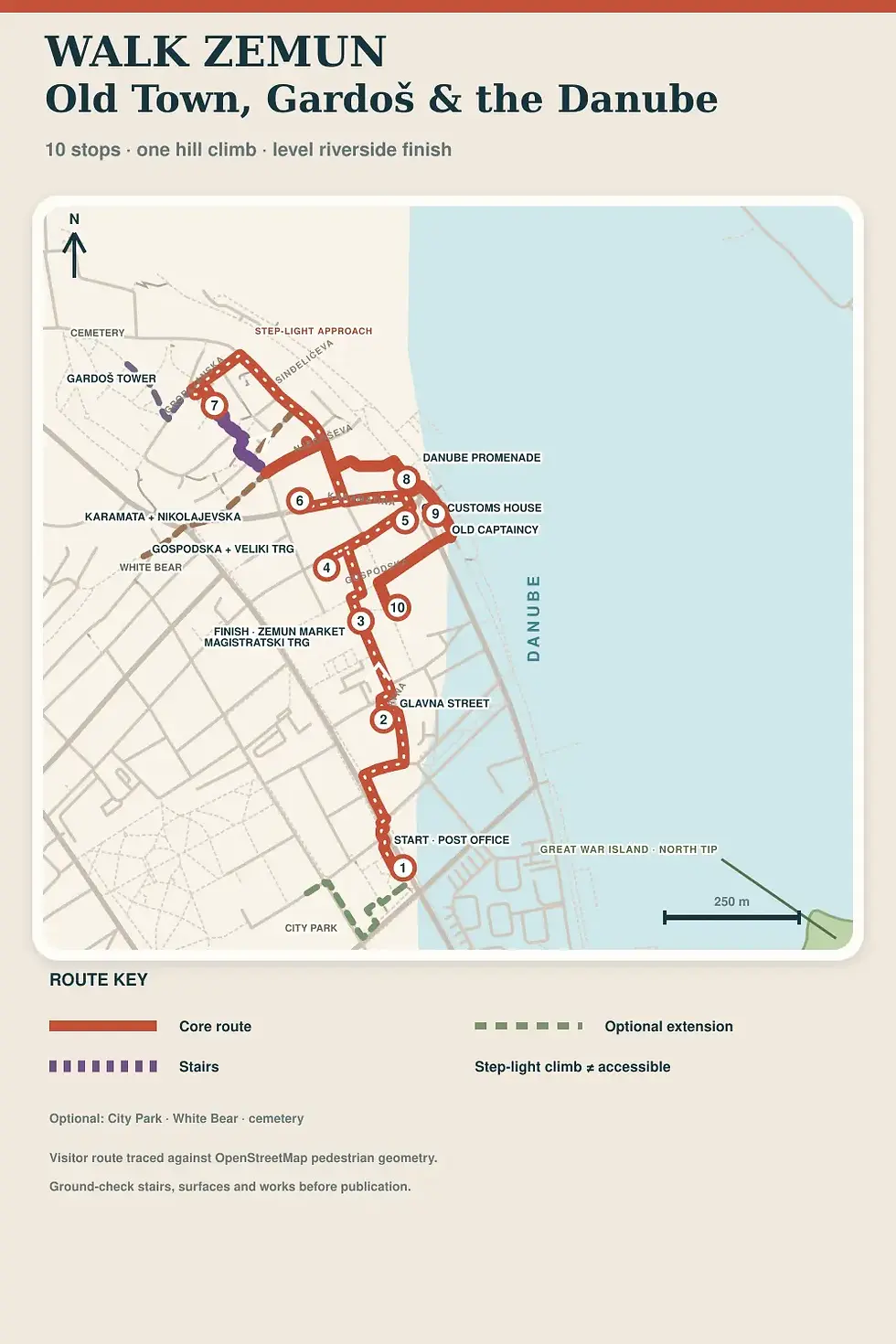
Map note: Use the numbered route map in this article rather than asking a navigation app for the shortest route to Gardoš. The shortest suggestion may use steep stairs or an inconvenient residential approach.
First, understand the shape of Zemun
Old Zemun occupies the lower ground beside the Danube and the slopes rising behind it.
Glavna Street forms the principal commercial spine. Magistratski Trg, Gospodska Street, Veliki Trg and the market create a compact historic centre, while Gardoš rises immediately to the north.
That geography determines the walk. Begin in the lower town, move through its civic and trading centre, climb Gardoš once and descend on the river side. The final section is level and unhurried, with the Danube on one side and the Zemun skyline behind you.
Zemun Park is worthwhile, particularly for the surviving churches associated with the former Kontumac quarantine complex, but it sits outside the tightest Old Town–Gardoš–Danube circuit. It appears here as an optional extension rather than making the core route longer and less direct.
Zemun's unusual urban character is not simply a mood. For centuries it developed separately from Belgrade, including a long period as a Habsburg frontier, trading and quarantine town. Our short history of Zemun explains that chronology. On this walk, the important thing is learning how to recognise its consequences in the streets.
Stop 1: Begin at Zemun Post Office on Glavna Street
The Zemun Post Office at Glavna 8 makes a better starting point than a vague instruction to begin “in central Zemun.” It is a recognisable protected building on the neighbourhood's main street and is close to several public-transport stops.
Before walking north, look across this part of Glavna Street. Zemun feels different from central Belgrade partly because of scale: historic buildings stand close to the pavement, façades create a continuous street edge and gates often conceal long courtyards behind relatively narrow fronts.
Nearby Spirta House, at Glavna 9, is one of the street's most distinctive buildings. Farther along, the House with the Sundial stands at Glavna 23. Do not reduce the walk to photographing decorated façades. Notice the repeated window rhythms, pitched roofs, carriage entrances, shopfronts and the depth of the plots.
Our guide to Zemun's historic architecture explains the styles and buildings in detail. Here, Glavna Street's job is to introduce the physical structure of the former town.
Allow: 10–15 minutes, longer if you take the Zemun Park extension.
Next: Continue along Glavna Street toward the old municipal centre.
Optional extension: Zemun Park and the former Kontumac
If you have an additional 30–45 minutes, begin in Zemun Park before joining Glavna Street.
The park preserves two small religious buildings connected with Zemun's former quarantine complex: the Orthodox Chapel of St Archangel Michael and Gabriel and the Catholic Chapel of St Roch.
The Kontumac was not a decorative park feature. Travellers, animals, goods and mail entering Habsburg territory could be inspected and isolated there to limit the spread of disease. The surviving buildings make more sense with that historical function in mind.
This extension is useful for history-focused visitors, but it is not necessary for the essential route.
Stop 2: Magistratski Trg and the Old Magistrate
Magistratski Trg introduces Zemun as a town that once administered itself rather than merely a picturesque riverside quarter. The Old Magistrate at Magistratski Trg 3 belonged to its municipal government, while the surrounding streets connected administration with commerce, worship and the market.
Pause long enough to understand the square as an ensemble. The value is not confined to one façade. Building heights, plot widths, street openings and the relationship between the square and Gospodska Street preserve the scale of the historic centre.
This is also the right place for Zemun's essential historical sentence: modern Zemun is part of Belgrade, but the two developed as separate towns for centuries and stood in different political territories for long periods. That is why visitors still experience Zemun as a centre with its own internal logic.
Allow: 10 minutes.
Next: Enter Gospodska Street and continue toward Veliki Trg.
Stop 3: Follow Gospodska Street into the old centre
Gospodska is less a single attraction than a connection between Zemun's civic and commercial spaces. Its pedestrian-friendly scale makes it easy to slow down, look above the shopfronts and see how private houses, businesses and public life occupy the same compact street.
At Gospodska 6, the House with the Chronogram carries a Latin inscription associated with its reconstruction after the destructive fire of 1788. Selected Roman numerals in the inscription encode the year 1792. It is a small detail, but a useful reminder that rebuilding is part of Zemun's history: the old core did not survive unchanged from one perfect period.
Continue toward Veliki Trg rather than treating Gospodska as a shopping detour. The sequence of street, square and market is part of what makes central Zemun legible on foot.
Allow: 10 minutes.
Next: Continue directly into Veliki Trg.
Stop 4: Veliki Trg and the Church of the Assumption
Veliki Trg is one of the clearest places to understand Zemun's compact centre. The Church of the Assumption of the Blessed Virgin Mary occupies a prominent position here, while the surrounding routes lead toward the market, river and streets beneath Gardoš.
Zemun's skyline was shaped by several religious communities. Orthodox and Catholic church towers still rise above the low roofs, while the surviving synagogue elsewhere in the old town recalls a Jewish community that contributed to Zemun's commercial and civic life before the Holocaust.
The square does not require a long catalogue of dates. Look instead at proximity: religious buildings, municipal institutions, merchant houses, customs facilities and the market all developed within a small walkable area. Zemun functioned as a complete town before it became part of metropolitan Belgrade.
Allow: 10–15 minutes.
Next: Make a short riverward turn toward the Old Customs House.
Stop 5: See the border town at the Old Customs House
The Old Customs House at Zmaj Jovina 26 is one of the buildings that makes Zemun's former role tangible. Its size and position close to the Danube reflect a town shaped by regulated movement: boats, passengers, merchants, animals and goods crossed an imperial border here.
The building was constructed in 1781, replacing an earlier customs facility. Rather than describing it as another attractive old façade, connect it to what happened around it.
Zemun's river economy required inspection, administration, storage, hospitality and communication. Those functions helped create the merchant and civic town visible today.
From this stop, turn back toward the streets at the foot of Gardoš. The landscape will begin to change from the more formal lower town to narrower routes adapting to the hill.
Allow: 5–10 minutes.
Next: Continue toward Karamatina and Njegoševa streets.
Stop 6: Karamata House and Nikolajevska Church
Karamata House, at Karamatina 17, and Nikolajevska Church, at Njegoševa 43, bring merchant history and religious life into the same small group of streets.
The Karamata family house is one of Zemun's most important protected residences. Its present appearance records several phases rather than one untouched construction moment. That layering is typical of a living town in which families adapted buildings over generations.
Nikolajevska Church is among the defining Orthodox landmarks below Gardoš. Keep voices low if a service is taking place, dress as you would for an active place of worship and do not assume that an interior will always be open for sightseeing.
This is the decision point for the climb.
Direct climb: Continue toward Lagumska and use the stairs leading to the tower area. This is the shortest and steepest option.
Step-light climb: From Njegoševa, turn uphill into Sinđelićeva, then left into Grobljanska. This avoids the principal stair flight but still involves a sustained incline and potentially uneven surfaces.
Neither choice makes the complete Gardoš section reliably wheelchair accessible. Visitors who cannot manage the incline may prefer to keep the walking route in the lower town and reach the upper area separately by taxi, subject to legal vehicle access and the final approach.
Allow: 15–20 minutes before the climb.
Next: Choose the direct or step-light approach to Gardoš Tower.
Optional detour: the White Bear House
The White Bear, or Beli Medved, at Vasilija Vasilijevića 10 is an optional detour for visitors interested in vernacular Zemun. It is traditionally described as one of the oldest surviving houses in the area, but claims about the precise age of its present fabric vary.
Treat it as an exterior historical stop, not a guaranteed visitor attraction. The surrounding streets are residential, and the detour should be shown with a dashed line on the map rather than inserted into the compulsory route.

Stop 7: Climb through the streets of Gardoš
The approach to Gardoš is part of the experience, not dead time between attractions.
Street widths change, houses adapt to the slope and roofs begin to overlap in the view. The formal geometry of the lower centre gives way to a more irregular hill-town landscape.
Walk slowly on cobbles and worn steps, particularly after rain or in winter. In summer, the climb is more comfortable in the morning or later afternoon because shade varies between the streets.
Remember that this is a residential area. Photograph buildings from public space, avoid pointing cameras into open homes and courtyards, and leave doorways and narrow passages clear.
Look closer: The word lagum appears around Gardoš because the hills contain cellars and underground passages cut into the loess. Their existence is part of the area's history, but they should not be presented as an open underground attraction unless access is organised and verified.
Allow: 10–20 minutes for the ascent, depending on route and pace.
Next: Continue to the Millennium Tower at Grobljanska 22.
Stop 8: Gardoš Tower and the medieval fortress remains
Gardoš Tower is the high point of the walk, both literally and visually. From the hill you can look across Zemun's roofs, the Danube and Great War Island, with New Belgrade and the wider city appearing beyond them according to visibility.
Two different periods occupy the site. The walls surrounding the tower are the remains of a medieval fortress. The present Millennium Tower was built in 1896 as part of celebrations marking one thousand years since the Hungarian conquest of the Carpathian Basin. Its popular association with John Hunyadi—Sibinjanin Janko—does not make the existing tower medieval.
Walk around the exterior before deciding whether to enter. The free hilltop already provides an elevated view; the upper tower level offers a higher and broader panorama when access is available.
Opening arrangements and admission can change. Check the complete Gardoš Tower visitor guide before travelling specifically for the interior, rather than relying on hours copied by third-party map listings.
Allow: 20 minutes for the exterior; approximately 40–60 minutes if entering and photographing the panorama.
Next: Descend toward the Danube using the mapped riverward route rather than retracing the ascent.
Optional extension: Gardoš Cemetery
The cemetery beside the fortress contains Orthodox, Catholic and Jewish sections and remains an active burial place. Its chapels, gravestones, languages and family monuments record Zemun's multi-confessional history, but it should be visited with the behaviour appropriate to a cemetery.
Use the main paths, keep voices low, avoid active funerals and do not treat graves as props. Add approximately 20–30 minutes. Visitors who only want the tower view should omit the extension.
Stop 9: Descend to Zemunski Kej
Use the riverward descent marked on the article map. This gives the walk a different perspective from the climb and prevents unnecessary backtracking. The descent can be harder on knees than the ascent, especially where the surface is steep, worn or wet.
As the river reappears between buildings, look back occasionally. Gardoš Tower, church towers and low roofs begin to form the Zemun skyline that is difficult to perceive while standing inside individual streets.
If you used the step-light approach uphill because stairs are difficult, do not automatically follow the direct stepped descent. Return via Grobljanska and Sinđelićeva, or use the verified lower-gradient line shown on the accessibility version of the map.
Allow: 10–15 minutes.
Next: Join Kej Oslobođenja beside the Danube.
Stop 10: Finish beside the Danube
Zemunski Kej is the natural final chapter. After the compact streets and climb, the view opens onto the Danube, Great War Island and a broad, mostly level promenade.
Turn south for the central quay, the Old Captaincy and Zemun Market. This is the best direction if you want to complete the loop, find transport or stop for food. Continue farther along the promenade only if you have time and energy; the quay extends well beyond the short section needed for this itinerary.
The riverfront is not simply an attractive ending. The Danube explains why Zemun became a trading, customs and transport town. From the bank, the relationship between the river, lower centre and Gardoš becomes visible as one landscape.
Our local guide to Zemunski Kej covers the longer promenade, timing, restaurants, seasonal conditions and how this riverbank connects with New Belgrade.
Near the Old Captaincy, choose your finish:
stop for coffee or a meal beside the river;
continue to Zemun Market on Masarikov Trg;
extend the walk south along the quay;
return to the public-transport stops around central Zemun.
If the market is a priority, do the route in the morning or begin there before walking to Glavna Street. Market activity becomes quieter later in the day, while the riverfront generally becomes more appealing toward late afternoon.
Which version of the route should you choose?
The essential 90-minute Zemun walk
Begin around Zemun Market or Veliki Trg, continue past Nikolajevska Church, climb to Gardoš Tower and descend to the Danube. This version gives you the three defining environments - old centre, hill and river - but leaves little time for interiors.
Choose it if Zemun is one part of a busy Belgrade day.
The complete three-hour route
Follow all ten core stops from the Post Office to the quay. Pause for architectural details, explore the exterior of the fortress and tower and finish at the market or Old Captaincy.
This is the best version for most first-time visitors.
The relaxed half-day in Zemun
Add Zemun Park, enter Gardoš Tower if it is open, stop for coffee and have lunch beside the Danube. Continue farther along the quay if the weather is comfortable.
Choose this version if Zemun is the main destination rather than an addition to central Belgrade.
The lower-town, step-free alternative
There is no honest way to describe the complete Gardoš circuit as step-free. For a gentler outing, remain in the lower centre: Glavna Street → Magistratski Trg → Gospodska Street → Veliki Trg → Old Customs House → central quay → Zemun Market.
This preserves Zemun's civic, commercial and river story without the hill. Pavement quality, kerbs and temporary obstructions should still be checked locally. If the tower is essential, approach the upper Gardoš area separately and confirm the final access conditions in advance.

When is the best time to walk around Zemun?
Morning is best if Zemun Market matters to you or if you are visiting during hot weather. Begin at the market, complete the old-centre section and reach Gardoš before the strongest sun.
Late afternoon creates the most satisfying sequence for views. Begin on Glavna Street, reach Gardoš while the light is softer and descend to the Danube for the evening. Do not leave the tower interior until the last possible moment without checking its current closing time.
Weekends bring more people to the market and promenade. The atmosphere can be enjoyable, but restaurants, parking areas and the quay are likely to be busier. After rain, allow more time around Gardoš because cobbles and steps may be slippery.
Practical advice before you start
Wear shoes with reliable grip. The hill section is not the place for unstable soles or heels.
Carry water in warm weather; the climb may feel more exposed than the short map distance suggests.
Save the route map offline in case your mobile connection is unreliable between narrow streets.
Treat churches as active places of worship, not guaranteed museum interiors.
Treat the cemetery as an active burial ground.
Do not enter courtyards, gates, tunnels or underground spaces merely because they appear open.
Check current public transport through the City of Belgrade's official system or a live journey planner on the day of travel.
Check tower access separately. Map listings and old articles can retain outdated hours.
Expect the market to be more active earlier in the day.
In high water, storms, snow or construction, follow local closures rather than the published route.
How to combine this walk with Belgrade from the water
Walking reveals Zemun at the scale of doors, courtyards, façades and stairways. The Danube turns those details into a skyline: Gardoš above the roofs, church towers across the lower town and Great War Island occupying the water in front.
Our guide to Belgrade from the water explains how Zemun relates to New Belgrade, the confluence and the historic city across the rivers. A Belgrade sunset cruise adds the reverse view from river level.
Belgrade Turtle Cruise does not board at Gardoš Tower or Zemunski Kej. The regular meeting point is in central Belgrade, so check the current booking page and allow enough time to travel from Zemun. Cruise dates, departure times, route and availability can change during the season.
Frequently asked questions about walking in Zemun
How long is the Zemun walking route?
The precise distance depends on the chosen Gardoš ascent and optional detours. Allow approximately 75–100 minutes of actual walking for the core circuit and around three hours for a comfortable visit with stops. The final published map should display the measured distance of its traced pedestrian line.
How much time do you need in Zemun?
Three hours is enough for the historic centre, Gardoš and a short Danube walk. Allow four to five hours if you want to visit the tower, explore the market, eat beside the river or continue farther along Zemunski Kej.
Where should you start a self-guided Zemun walking tour?
Zemun Post Office at Glavna 8 is the clearest start for the complete route. It provides a precise landmark on the main street and leads naturally through the historic centre toward Gardoš. Begin at Zemun Market instead if morning market activity is your priority.
Is the route circular?
It is mostly circular. The recommended route begins on Glavna Street and finishes near Zemun Market and the central quay, a short walk from the starting area. It uses different approaches for the climb and descent around Gardoš.
Is the climb to Gardoš Tower difficult?
It is short but can feel steep. The direct route includes stairs, while the alternative through Sinđelićeva and Grobljanska avoids the principal stair flight but still climbs. Heat, rain and footwear can make a noticeable difference.
Can you reach Gardoš Tower without using stairs?
You can avoid the principal stair route by continuing from Njegoševa into Sinđelićeva and then Grobljanska. This is step-light rather than fully accessible: it still includes an incline and may have uneven surfaces or obstacles.
Is the complete walk suitable for wheelchairs or strollers?
The complete hill route cannot be presented as reliably wheelchair or stroller accessible because of slopes, cobbles, stairs, kerbs and changing pavement conditions. The lower old centre and quay provide a gentler alternative, although local conditions should still be checked.
Is the Zemun walking route free?
Yes. The streets, squares, Gardoš exterior and river promenade can be explored without charge. Admission may apply if you enter Gardoš Tower, and opening or worship arrangements may affect access to interiors.
Can you combine Zemun with a Belgrade river cruise?
Yes, but they are separate experiences with different starting points. Complete the walk earlier in the day, then allow travel time to the cruise meeting point in central Belgrade. Do not assume that a central Belgrade cruise boards from Zemunski Kej.
Is Zemun safe to walk around in the evening?
The busy central streets and quay are generally used into the evening, but ordinary city precautions still apply. Around Gardoš, choose lit routes, watch uneven surfaces and avoid isolated stairways if you are uncomfortable after dark.
Zemun works best as a sequence
Zemun is easy to underestimate because its principal landmarks are close together on a map. The experience comes from the transitions between them: formal Glavna Street becomes a network of old squares; merchant and customs buildings give way to the slope; Gardoš opens over the roofs; the descent ends at the Danube.
Followed in that order, the route explains more than a checklist of attractions. It shows how a separate town grew between river, border and hill and why Zemun still feels like a destination within Belgrade rather than just another neighbourhood.


Comments