
Zemun Market Guide: What to See, Buy and Eat

Visit Zemun Market between approximately 8 and 11 in the morning, when the produce stalls are active and you still have time to explore the old centre, climb Gardoš or continue along the Danube. The market occupies Masarikov Trg at the edge of Zemun's historic centre and sells fruit, vegetables, dairy products, cured meat, pantry goods, flowers and freshwater fish.
Bring Serbian dinars in smaller notes. Watch how each stall operates before handling produce, and do not wait until the official closing time if you want the fullest selection. A market can remain formally open while individual traders have already sold out or begun packing.
Zemunska pijaca is most interesting because it is ordinary. It is not a staged historical attraction: it is where people buy food, compare prices, talk to familiar sellers and complete part of the weekly household routine. Visitors are welcome, but the best experience comes from participating respectfully rather than treating the people working there as scenery.
The official market operator currently lists general working hours of 06:00–19:00. Individual stalls, permanent businesses, prepared-food counters and special events may follow different schedules. The information in this guide was last checked on 25 August 2026; verify holidays and current operating information before making a special trip.
For a wider introduction to the neighbourhood, begin with our complete guide to the best things to do in Zemun.
Zemun Market at a glance
Market detail | Practical answer |
Official name | Pijaca Zemun; commonly called Zemunska pijaca |
Address | Masarikov Trg 17, Zemun |
Market type | Green market with food, flowers, specialist sellers and fish facilities |
Official general hours | Currently listed as 06:00–19:00 |
Best visitor time | Approximately 08:00–11:00 |
Typical visit | 30–45 minutes |
With breakfast or lunch | 60–90 minutes |
Payment | Carry Serbian dinars; do not assume every stall accepts cards |
Best for travellers | Seasonal produce, sealed pantry goods, flowers, breakfast ingredients and everyday atmosphere |
Nearby | Magistratski Trg, Gospodska, Veliki Trg, Zemunski Kej and Gardoš |
Terrain | Comparatively level, with crowds, kerbs, wet areas and temporary obstructions possible |
Simple market route: Produce stalls → dairy and pantry goods → fish area → flowers and plants → prepared food or breakfast → exit toward the historic squares or Danube.

Where is Zemun Market?
Zemun Market occupies Masarikov Trg, between the compact historic centre and the Danube promenade.
Magistratski Trg lies immediately to the west, beside Zemun's former municipal centre.
Gospodska Street connects the surrounding squares, while Kej Oslobođenja and the Danube lie to the east. Gardoš rises behind the lower town to the north.
That position makes the market easy to use in several ways:
begin a morning in Zemun here;
buy fruit or picnic ingredients before walking beside the Danube;
stop after exploring Glavna Street and the old squares;
finish a longer route after descending from Gardoš;
eat at one of the market businesses or continue to a restaurant on the quay.
Our self-guided Zemun walking route connects the market with Glavna Street, the old centre, Gardoš Tower and the Danube. This guide concentrates on the market itself: how it functions, what to buy and how to shop without feeling lost.
What kind of market is Zemunska pijaca?
The Serbian word pijaca generally means a market where individual traders sell produce, food, flowers and other goods from stalls or small permanent shops.
It does not automatically mean a producers-only farmers' market. Some people behind the stalls may grow, raise or make what they sell. Others may be specialist traders or resellers buying through wholesale supply chains. A table full of tomatoes does not by itself prove that the seller grew them, and a handwritten sign does not make a product organic.
That is not a criticism. Neighbourhood markets work by combining different forms of trade and giving shoppers a broad choice in one place. It simply means visitors should avoid attaching unsupported stories to ordinary products.
If buying directly from a producer matters to you, ask:
Da li je ovo vaše? - Is this your own produce/product?
You may need to make the question more specific:
Da li vi ovo uzgajate? - Do you grow this?
Da li vi ovo pravite? - Do you make this?
Odakle je? - Where is it from?
Not every seller will speak English, and not every answer will fit neatly into one category. Keep the exchange friendly and do not demand a complete supply-chain audit over a small purchase.
What to see at Zemun Market
The market is compact enough to explore without a rigid itinerary. Its value comes from moving between sections and noticing how the offer changes with the season.
Seasonal fruit and vegetables
Produce stalls form the market's everyday centre. Instead of searching for one permanent list, look at what appears repeatedly across several sellers. Abundance usually tells you more about the season than a decorative “local produce” sign.
Typical patterns include:
Spring: leafy greens, radishes, spring onions, strawberries and later cherries;
Summer: tomatoes, peppers, cucumbers, courgettes, melons, watermelons, peaches and other stone fruit;
Autumn: grapes, plums, apples, pears, pumpkins and vegetables bought for winter preserves;
Winter: cabbage, potatoes, onions, root vegetables, apples, citrus fruit and preserved products.
Weather and agricultural supply shift the exact timing. An early warm spring, heavy rain or poor harvest can alter both availability and price. Treat a seasonal calendar as orientation, not a guarantee.
Look beyond flawless appearance. Market produce may vary in size and shape, while supermarket-style fruit may also appear. Ask where something comes from rather than deciding its origin from appearance alone.

Dairy products
Market dairy counters and specialist sellers can introduce visitors to products that do not always translate neatly.
Serbian term | What it means |
sir | Cheese; a broad category rather than one specific style |
beli sir | White brined cheese |
mladi sir | Young, mild cheese |
stari sir | More mature cheese |
kajmak | Rich cultured milk-skin product, somewhere between a spread and soft dairy delicacy |
kiselo mleko | Cultured sour milk |
jogurt | Commonly a drinkable yoghurt in Serbia |
Ask whether a product is made from cow, sheep or goat milk if that matters to you. Fresh cheese and kajmak need refrigeration, so they make more sense for visitors staying in an apartment than for someone carrying food through a hot sightseeing day.
Tasting should never be assumed. Accept a sample when offered or ask politely; do not reach into a product display.
Meat and cured products
Depending on the current mix of specialist shops and sellers, you may see:
pršuta, or dry-cured ham;
kulen, a paprika-seasoned cured sausage;
smoked sausages;
čvarci, or pork cracklings;
fresh and roasted meat;
prepared meat products.
These can be excellent for a local breakfast or apartment meal, but they are not always practical souvenirs. Consider refrigeration, packaging, airline rules and the customs regulations of the country you are entering.
Do not assume that every product is homemade, organic or produced in Zemun. Ask about origin when it affects your decision.
Flowers, plants and seedlings
Cut flowers, potted plants and seasonal seedlings give the market one of its most visible changes through the year.
In spring, the plant offer may expand as residents prepare balconies and gardens. Around holidays and family occasions, cut-flower trade can become particularly active. These stalls are photogenic, but they are also working spaces where fragile goods are being handled and sold.
Stand clear of narrow aisles, do not rearrange plants for a photograph and ask before taking a close portrait of a seller.
Pantry goods and winter preserves
The exact offer varies, but market shopping may include:
honey;
jams and fruit spreads;
ajvar and other vegetable preserves;
pickled vegetables;
dried fruit;
nuts and seeds;
tea, spices or coffee;
juice, syrup, wine or rakija during specialist events.
These are often the most practical purchases for travellers, especially when commercially sealed and labelled. Check packaging, weight and liquid restrictions before putting a glass jar in hand luggage.
The market occasionally hosts seasonal programmes such as winter-preserve caravans and craft markets. Those events may bring sellers who are not present during ordinary trading days.
The fish area and Zemun's river tradition
Fish is the part of Zemun Market most directly connected with the Danube, but it requires careful language.
Zemun has a genuine history of alasi, or river fishermen, as well as boats, fishing trade, fish soup and riverside restaurants. Current market publicity continues to identify freshwater fish as part of the market's offer, and the dedicated fish section is sometimes called the Alaska pijaca-the fishermen's market.
However, three different facts must remain separate:
The species may be freshwater fish.
The fish may be sold at a market beside the Danube.
The individual fish may-or may not-have been caught locally.
Freshwater fish can come from aquaculture, another Serbian waterway or a wider legal supply chain. Imported fish and seafood may also be sold. Ask rather than assuming that everything arrived from a Zemun fishing boat that morning.
Useful terms include:
Serbian | English |
smuđ | Pike-perch or zander |
šaran | Carp |
som | Catfish |
pastrmka | Trout |
štuka | Pike |
rečna riba | River or freshwater fish |
morska riba | Sea fish |
sveža | Fresh |
zamrznuta | Frozen |
očišćena | Cleaned |
Ask:
Odakle je riba? - Where is the fish from?
Da li je sveža ili zamrznuta? - Is it fresh or frozen?
Možete li da je očistite? - Can you clean it?
Wild sterlet, called kečiga, must not be promoted as current local catch. Serbia introduced a permanent prohibition on catching wild sterlet from 1 January 2019. If it appears in legal trade, origin must be verified rather than romanticised.
Buying raw fish is practical only if you have appropriate refrigeration and cooking facilities. If you would rather taste freshwater fish ready prepared, use our guide to fish restaurants along the Danube in Zemun.
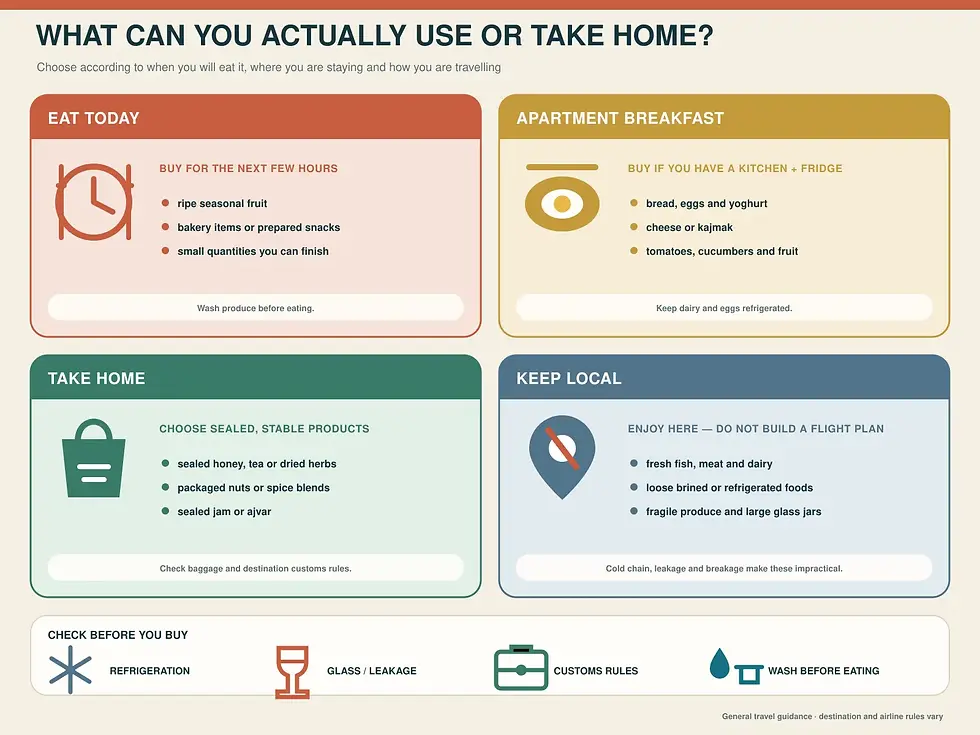
What should a visitor buy at Zemun Market?
The best purchase depends less on what looks impressive and more on what you can store, wash, carry or take across a border.
Best things to eat the same day
A small amount of seasonal fruit
Tomatoes or peppers for an apartment meal
Bread or pastry from a verified bakery nearby
A sealed yoghurt drink
Nuts or dried fruit
Prepared food from an operating licensed counter
Cheese or kajmak only when you can refrigerate it promptly
Wash fruit and vegetables before eating. A shiny pile of cherries is not automatically ready to eat directly from the stall.
Best for an apartment breakfast
Zemun Market is especially useful for travellers with a kitchen or refrigerator.
A simple Serbian-inspired breakfast could include:
tomatoes, peppers and cucumber;
white cheese or kajmak;
eggs;
bread from a bakery;
yoghurt;
seasonal fruit;
honey or jam.
Buy only the quantity you will use. Markets are ordinary shopping places, so asking for two tomatoes or half a kilogram of fruit is completely reasonable.
Best food souvenirs
Choose products that are sealed, labelled and easy to transport:
honey;
jam;
commercially packed ajvar;
dried fruit;
nuts;
tea or spice mixtures;
packaged sweets;
sealed preserves.
Check the ingredients if allergies matter. Also check whether the container exceeds hand-luggage liquid rules and whether your destination permits the product to enter.
Better kept for local use
These products are usually poor travel souvenirs:
raw fish;
fresh meat;
fresh soft cheese;
kajmak without refrigeration;
unlabelled homemade jars;
large glass containers;
plants, seeds and seedlings crossing international borders.
They may be excellent purchases for a local household while still being impractical for a visitor.
What can you eat at Zemun Market?
Zemun Market is no longer only a place to buy raw ingredients. Small food businesses operate around or within the market environment, while bakeries, cafés and restaurants surround the square.
That does not mean every food business follows the market's 06:00–19:00 schedule. Each has its own working days, reservation rules and service style.
Pretop: roast pork in a market setting
Pretop is a small, meat-focused market business associated with roast pork, house bread and a deliberately informal atmosphere. It has very limited seating and should not be imagined as a conventional indoor restaurant.
Choose it when you want a rich Serbian meat meal and the market setting is part of the appeal. It is unsuitable for vegetarians and may not suit visitors needing spacious seating, a quiet meal or an on-site toilet.
Opening days and hours require direct confirmation. Small businesses can close for events, sell out or alter their schedule more easily than a large restaurant.
Koordinata: a small seasonal bistro
Koordinata operates as a compact market bistro with a changing, chef-led menu rather than a fixed list of traditional market snacks. Its small number of tables and popularity make reservation useful.
Choose it when you want a complete meal and contemporary interpretation of seasonal ingredients. Do not promise one famous dish permanently: menus change, and that change is part of the concept.
Because it may open later than the produce market, a visitor can shop in the morning and return for lunch or dinner rather than expecting service at 08:00.
Vilina Kuhinja: cooked food to take away
Vilina Kuhinja is listed at local 6 within the market and offers a broad changing selection of cooked food for takeaway. Listed examples include beans, stuffed cabbage, moussaka, stews, grilled vegetables, fish soup and seasonal dishes.
This is more useful for apartment travellers and local workers than for someone expecting a formal seated restaurant. Ask what is available that day, whether it needs reheating and how long it can safely remain unrefrigerated.
Roast meat and other specialist counters
Market listings also identify roast-meat businesses such as Veseli Šumadinac. These can be useful for takeaway food, but their working days and available cuts must be checked before publication and periodically afterward.
The important editorial rule is not to turn the article into a permanent directory. A stable market guide can explain how to choose food, while a small “currently operating” box can be reviewed every three to six months.
Three easy Zemun Market breakfasts
1. The bakery breakfast
Buy burek or another savoury pastry from a verified nearby bakery, add a bottle or cup of yoghurt and have coffee around the square.
Burek is normally bought from a bakery, not from a fruit-and-vegetable stall. The market and surrounding businesses form one food area, but they are not all managed by the market.
2. The apartment breakfast
Buy tomatoes, cucumber, white cheese, eggs and fruit at the market, then collect fresh bread nearby. This is the most practical way to turn market shopping into a complete meal without trying to eat from shopping bags on the pavement.
Keep dairy and eggs cool and wash produce before serving.
3. The sit-down market meal
Reserve Koordinata or choose another verified operating food business when you want seating and a composed meal rather than ingredients. Opening times may begin later than the produce trade, so plan the market visit and meal as separate stages.

How shopping works at a Serbian market
Bring Serbian dinars
Carry cash in smaller notes and coins. Some permanent shops or food businesses may accept cards, but individual produce stalls should not be assumed to have card terminals.
If you only have a very large banknote, ask before the seller weighs and bags a small purchase. Do not expect a stallholder to act as a currency-exchange service.
Check the price unit
Produce is commonly priced per kilogram, but flowers, herbs, eggs or packaged goods may be priced per piece, bunch, container or defined quantity.
Useful phrases:
Serbian | English |
Koliko košta kilogram? | How much is one kilogram? |
Pola kilograma, molim. | Half a kilogram, please. |
Dajte mi dve, molim. | Give me two, please. |
Samo malo. | Just a small amount. |
Koliko je sve zajedno? | How much is everything together? |
To je sve, hvala. | That is all, thank you. |
Numbers, pointing and a friendly tone usually solve more than perfect grammar.
Ask before selecting produce yourself
Watch the seller and other customers. At some stalls, shoppers choose their own fruit and vegetables. At others, customers point and the seller selects and bags the produce.
Do not squeeze fruit, dig through a neatly arranged display or begin filling a bag without checking. A simple gesture and Može? -“Is it okay?” - is enough.
Bargaining is not the point
Routine food shopping is not an invitation to aggressively negotiate every price. Prices are normally displayed or quoted, and trying to reduce the cost of a small purchase for entertainment can feel disrespectful.
A seller may round the final amount, offer a lower price for a large quantity or add an extra item. Let that happen naturally rather than turning an ordinary transaction into a performance.
Accept samples only when offered
Some sellers may offer a piece of fruit, cheese or another product. Accept or decline politely. Never take a sample from the display without permission.
Bring a reusable bag
A foldable shopping bag makes small purchases easier to carry and reduces the need for multiple thin bags. Bring a separate leak-resistant bag if buying cheese, meat or fish.
Photography and respectful behaviour
You can photograph the overall colour and activity of the market without treating individual sellers as exhibits.
Follow a few simple rules:
ask before taking a close portrait;
do not photograph cash, payment or private conversations;
keep aisles and stall fronts clear;
do not move products for a composition;
make a purchase if you spend significant time photographing a seller's work;
avoid recording people after they indicate discomfort;
supervise children around fragile produce, knives and wet fish areas.
The market does not become more authentic when photographed without consent. Its authenticity comes from continuing to serve Zemun residents.
When is the best time to visit Zemun Market?
Between 08:00 and 10:00
This is the best period for serious shopping, fresh selection and seeing the market operating at its everyday pace. It is also more comfortable in summer before the strongest heat.
Between 10:00 and 12:00
This is the easiest window for most visitors. The market should still feel active, while cafés, prepared-food businesses and surrounding sights are more likely to be operating.
In the afternoon
The official market may remain open, but individual produce sellers can have reduced selection or begin packing before closing. Afternoon is better for combining the square with a café or restaurant than for expecting the market at its fullest.
Saturday
Saturday morning can be busy and sociable. It suits visitors who enjoy atmosphere, but narrow aisles and queues may make detailed photography or mobility more difficult.
Sunday
Sunday can still be useful, but individual traders may follow a shorter day. Arrive in the morning rather than trusting a general closing time.
Holidays
Holiday arrangements are announced separately. Zemun Market sometimes remains open on days when other green markets close, but often with shortened hours. Always check the operator's current announcement.
Seasonal events and special markets
Masarikov Trg and Zemun Market are also used for occasional public programmes.
Recent examples have included:
BUM craft markets;
spring and seasonal bazaars;
winter-preserve caravans;
food and craft festivals;
evening or night markets.
These events may add handmade jewellery, toys, ceramics, natural cosmetics, preserved foods, wine, rakija or prepared dishes to the ordinary offer. They are useful for gifts but should not be confused with the permanent daily market.
Do not plan a visit around an event mentioned in an old article. Check current announcements from JKP Beogradske pijace or the City of Belgrade because dates, hours and participating sellers change.
A simple 60-minute Zemun Market route
Stop 1: Enter from Masarikov Trg
Pause at the edge rather than in the central flow. Identify the main produce rows, permanent businesses, fish area and exits toward the old centre and river.
Stop 2: Walk the seasonal produce stalls
Look for items repeated across multiple sellers. Buy a small amount of fruit or an ingredient you will genuinely use rather than collecting products merely because they look local.
Stop 3: Visit dairy and pantry sellers
Compare cheeses, kajmak, honey, preserves and dried goods. Ask about origin and refrigeration before buying.
Stop 4: Find the fish area
Notice which species are labelled as freshwater or sea fish. Ask about origin if you are buying, but avoid blocking working counters for a long explanation when the market is busy.
Stop 5: Pass the flower stalls
The changing plants and flowers provide a clear marker of the season. Ask before close photography.
Stop 6: Choose breakfast or takeaway food
Select a current market food business, go to a bakery nearby or keep your purchases for an apartment meal. Do not assume every counter opens with the produce stalls.
Stop 7: Continue into Zemun
Exit toward Magistratski Trg and Gospodska for the historic centre, or turn toward Kej Oslobođenja for the Danube promenade.
Is Zemun Market accessible?
The market occupies comparatively level ground, making it easier than the slopes and stairs around Gardoš. That does not make every part reliably accessible.
Potential obstacles include:
kerbs at approaches and crossings;
narrow spaces between stalls;
boxes and temporary displays;
crowds on weekend mornings;
wet or slippery surfaces near produce and fish;
uneven paving;
limited turning space around popular food counters.
Visitors using wheelchairs, walkers or strollers should choose a quieter weekday morning where possible. The final article map should mark the widest confirmed entrance and the nearest verified accessible toilet. Do not label the entire site step-free until those details have been checked on location.
How to combine the market with Zemun
Market plus the old town
After shopping, cross into Magistratski Trg, walk through Gospodska and Veliki Trg and continue toward Nikolajevska Church. This is the easiest short cultural combination.
Market plus Gardoš
Visit the market first, then climb Gardoš before the day becomes hot. Carry only light, non-perishable purchases. Fresh dairy, raw meat and fish should not accompany you up the hill.
Use the complete guide to Gardoš Tower for the climb and current visitor considerations.
Market plus the Danube
Buy fruit, bread or another practical snack and continue to Zemunski Kej. Wash produce before eating and use proper waste bins rather than leaving packaging along the river.
Our local guide to Zemunski Kej explains the promenade, walking directions and riverfront stops.
Market plus a fish lunch
The market can introduce the species; a restaurant can show how they are prepared. Our guide to fish restaurants in Zemun distinguishes traditional river fish, fresh Adriatic catch and mixed-group dining.
From Zemun's market to its river landscape
Zemun Market shows how the neighbourhood's river history survives in everyday trade: fish, food, boats, the quay and the old commercial centre remain closely connected.
From the Danube, that relationship becomes visible at a larger scale. Gardoš rises above the roofs, church towers mark the lower town and the quay stretches beneath them. Our guide to Belgrade from the water explains how Zemun relates to Great War Island, New Belgrade and the confluence.
A Belgrade sunset cruise adds the river-level perspective after exploring the market and streets on foot.
Belgrade Turtle Cruise does not board from Zemun Market or Zemunski Kej. Check the current booking page for the central Belgrade meeting point, operating dates and departure time, and allow enough time to travel from Zemun.
Frequently asked questions about Zemun Market
What time does Zemun Market open?
JKP Beogradske pijace currently lists general working hours of 06:00–19:00. Individual traders and food businesses may keep shorter hours, and holiday schedules can change. Morning is the most reliable time for the complete market experience.
What is the best time to visit Zemun Market?
Visit between approximately 08:00 and 11:00. The produce selection should still be strong, the market is visibly active and you can continue sightseeing before the afternoon. Arrive earlier during hot summer weather.
Is Zemun Market open on Sundays?
The market normally trades on Sundays, but individual stalls may close earlier or not operate. Visit in the morning and verify holiday arrangements separately.
What can you buy at Zemun Market?
The market sells seasonal fruit and vegetables, dairy products, meat and cured products, pantry goods, flowers, plants and freshwater fish. The exact mix depends on the season and the traders operating that day.
Can you eat at Zemun Market?
Yes. Small businesses within or around the market sell prepared food, roast meat, cooked takeaway dishes and chef-led meals. Bakeries, cafés and restaurants also surround the square. Each business has its own schedule, which may differ from market hours.
Is Zemun Market cash-only?
Not necessarily, but carrying Serbian dinars is strongly recommended. Many individual stalls may accept only cash, while some permanent shops and restaurants may take cards.
Can tourists buy small quantities?
Yes. Ask for half a kilogram, a few pieces or another small amount. You do not need to buy the quantities a local household might purchase for an entire week.
Is bargaining expected at Serbian markets?
Not for routine small food purchases. Prices are normally displayed or quoted. A seller may round the total or offer a discount for volume, but aggressive bargaining is unnecessary.
Can you take photographs at Zemun Market?
Wide photographs are normally less intrusive, but ask before taking close portraits of sellers. Do not block aisles, rearrange products or photograph payment without permission.
Does Zemun Market sell fresh fish?
Freshwater fish is a recognised part of the market's offer, but species, origin and daily availability change. Ask whether a fish is fresh or frozen and where it came from before purchasing.
Is the fish caught in the Danube?
Not automatically. Fish sold at a market beside the Danube may be locally caught, farmed, imported or sourced elsewhere. A freshwater species name alone does not establish origin.
What market food can you take home as a souvenir?
Sealed honey, jam, ajvar, dried fruit, nuts, tea, spices and other labelled pantry goods are usually the most practical. Check luggage and customs restrictions before travelling with food.
How long do you need at Zemun Market?
Allow 30–45 minutes for a walk and small purchase. Allow 60–90 minutes if you plan to eat, compare products or practise shopping rather than only take photographs.
Is the market close to Gardoš and the Danube?
Yes. The market is beside the historic centre and only a short walk from the Danube promenade. Gardoš rises behind the old town, although reaching the tower requires an uphill walk and may involve stairs.
The market is everyday Zemun
Zemun Market does not need to be transformed into a tourist attraction to be worth visiting.
Its value lies in the ordinary relationships around it: seasonal produce arriving on the stalls, residents returning to familiar sellers, fish trade recalling the Danube, food businesses adapting the market to new habits and the old centre continuing around the square.
Come in the morning, carry cash, buy something you can actually use and leave room for the people completing their daily shopping. That is the most rewarding way to experience Zemunska pijaca - and the clearest glimpse of Zemun as a living neighbourhood rather than a collection of monuments.


Comments