
The Oldest House in Belgrade: The Story of Cara Dušana 10

At number 10 Cara Dušana, an ochre-coloured house with a steep tiled roof preserves an unusually early layer of Belgrade beyond the fortress. Built during Habsburg rule, generally dated to 1724–1727, it is widely described by city and heritage authorities as Belgrade’s oldest surviving house.
That label needs one important qualification. Cara Dušana 10 is best understood as the oldest surviving residential-commercial house in historic Belgrade. Older structures survive inside Belgrade Fortress, while other “oldest house” claims depend on whether Zemun is included within the modern city and how a building’s age and original use are defined.
The house is not a public museum. Visitors can see its protected exterior from the street and place it within a wider walk through Dorćol, but should not enter private or commercial areas without permission.
Cara Dušana 10 at a glance
Detail | Practical answer |
Address | Cara Dušana 10, Dorćol, Belgrade |
Common date | 1724–1727 |
Historical period | Habsburg administration of Belgrade, 1717–1739 |
Early association | Elijas Fleischmann, a saddler and leatherworker |
Building type | Residential-commercial house |
Heritage status | Protected cultural property |
Public access | Exterior viewing only unless a current occupant explicitly offers access |
Time needed | About 5–10 minutes for the façade; longer as part of a Dorćol walk |
Best paired with | Bajrakli Mosque, Jewish Street, the Museum of Science and Technology and Lower Dorćol |
Is Cara Dušana 10 really the oldest house in Belgrade?
It is the city’s standard answer, but “oldest” is not a single, self-explanatory category.
Claim | Why it differs |
Cara Dušana 10 | Commonly presented as the oldest surviving house in Belgrade; more precisely, an early residential-commercial building outside the fortress |
Buildings within Belgrade Fortress | Some structures and archaeological remains are much older, but they are military, religious or archaeological rather than an ordinary street house |
The White Bear in Zemun | Often assigned an early date, but its chronology is debated and Zemun developed as a separate town before becoming part of modern Belgrade |
The Vuk and Dositej Museum building | Another very early surviving Ottoman-period house whose dating is sometimes placed close to, or before, Cara Dušana 10 |

The careful conclusion is therefore more useful than a dramatic superlative: Cara Dušana 10 is one of the very few surviving eighteenth-century houses in central Belgrade and is officially promoted as the city’s oldest house. It offers rare physical evidence of the street city that grew beyond the fortress walls.
A house from Habsburg Belgrade
The building belongs to a short but transformative period. Habsburg forces captured Belgrade from the Ottoman Empire in 1717 and governed it until 1739. During those two decades, the authorities attempted to reshape parts of the city according to Central European military and urban ideas.
Belgrade was not simply rebuilt all at once. Existing neighbourhoods, displaced communities, defensive demands, new settlers and administrative plans overlapped. The result was a city in transition rather than a clean replacement of “Ottoman” by “Austrian” Belgrade.

Cara Dušana 10 matters because so little domestic architecture from that phase survives. Grand political changes are usually explained through wars and treaties; this house brings the period down to the scale of a workshop, shopfront and home.
For the wider sequence of empires, communities and streets, read our Short history of Dorćol.
Who was Elijas Fleischmann?
The house is traditionally linked with Elijas Fleischmann, a saddler and leatherworker. His trade fits the practical economy of an eighteenth-century border city: horses, transport and military life created demand for harnesses, straps and other leather goods.
The association also helps explain the building’s mixed character. This was not conceived as a detached aristocratic residence. It combined livelihood and domestic life, reflecting a street in which workshops, storage, selling and living could occupy the same property.
Not every detail of the house’s first occupants can be reconstructed with certainty. The strongest interpretation stays close to what the building itself and protected-property records support: an early eighteenth-century residential-commercial house connected with a craftsman.
What to notice in the architecture
The façade can look modest beside Belgrade’s later nineteenth-century buildings. Its value lies precisely in that difference.

The steep roof
The tall tiled roof gives the house its most recognisable silhouette. It reflects a building tradition shaped by climate, available materials and Central European influence during Habsburg rule.
A house made for work and living
The ground floor historically supported commercial or workshop functions, with residential space above. That vertical mixture remains familiar in old European streets, but few examples from this early phase of Belgrade survive.
Thick walls and small openings
The building’s proportions, wall mass and relatively restrained openings belong to a period before the broad display windows and decorated façades that transformed central Belgrade in the nineteenth century.
Ventilation details
Openings associated with roof and storage ventilation are among the practical details worth noticing. They should be read as functional architecture, not as decorative curiosities added for visitors.
Because the house has undergone repairs and alterations, the façade is not an untouched time capsule. Its significance comes from the survival of the building’s early form through repeated changes of government, ownership and use.
What happened after the Habsburg period?
The Ottoman Empire recovered Belgrade in 1739. The house consequently survived not only physical danger but another major shift in political order and urban culture.
During the nineteenth century, Belgrade changed again as the Serbian state gained autonomy and the old town was progressively rebuilt. Many earlier houses disappeared through fire, demolition, street regulation, redevelopment or simple decay. Cara Dušana itself became a major urban street rather than the edge condition it had once approached.
In the twentieth century, modern construction further altered Dorćol. The survival of number 10 became increasingly exceptional: an eighteenth-century building embedded in a neighbourhood containing Ottoman monuments, nineteenth-century houses, interwar apartment blocks and postwar development.
That layered streetscape is the central theme of our Self-guided Dorćol walking route.
The tunnel story: history or legend?
One of the most repeated stories about Cara Dušana 10 describes a tunnel running from the house toward Belgrade Fortress or the Danube. Variations add military escape routes, underground passages or hidden connections.
These stories are part of the building’s modern folklore, but they should not be presented as established architectural fact without archaeological documentation. Cellars, service spaces and buried infrastructure can easily accumulate larger legends in an old city.
The responsible version is simple: a tunnel tradition exists, but the route, date and purpose commonly attributed to it have not been demonstrated well enough to treat the story as verified history.
Visitors should never attempt to enter cellars, yards or adjoining property to investigate it.

Why the house matters to Dorćol
Cara Dušana 10 makes several layers of Dorćol visible at once.
It belongs to the Habsburg interlude but stands in a district more often explained through its Ottoman name.
Its craftsman association reveals workaday urban life rather than court or military history alone.
Its mixed residential-commercial use anticipates the continuing relationship between street business and domestic space.
Its survival shows how exceptional early buildings became as Belgrade repeatedly rebuilt itself.
The house also prevents Dorćol’s history from being reduced to one cultural label. Ottoman, Jewish, Serbian, Habsburg, Balkan and Central European influences did not occupy sealed historical compartments; they succeeded, displaced and overlapped one another in the same streets.
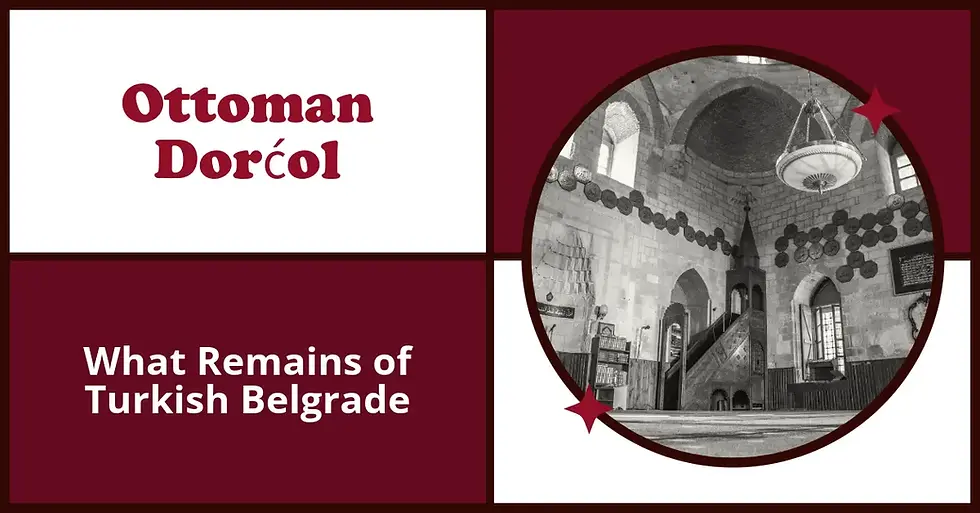
For the Ottoman layer, continue with Ottoman Dorćol: What Remains of Turkish Belgrade Today. For the neighbourhood’s domestic fabric, see Hidden Courtyards, Passageways and Old Houses of Zemun and Dorćol
How to visit Cara Dušana 10
The house stands on Cara Dušana, between the historic centre and Lower Dorćol. It works best as a short interpretive stop rather than a destination requiring a separate journey.
Approach from the public pavement and look across the street when traffic allows a safe view. Notice the roofline first, then compare the building’s height and proportions with its later neighbours.
Do not expect:
a ticket office;
regular interior tours;
museum displays;
access to the courtyard or cellar;
confirmation of tunnel legends on site.
The building may contain active private or commercial uses. Respect doors, windows, occupants and customers, and avoid blocking the pavement.
A useful heritage sequence nearby
This compact sequence reveals how several periods meet in northern Dorćol:
Bajrakli Mosque - the neighbourhood’s surviving Ottoman mosque.
Jevrejska Street - an entry point for understanding historic Jewish Dorćol.
Cara Dušana 10 - an early Habsburg-period residential-commercial house.
Museum of Science and Technology - industrial and technological history in Lower Dorćol.
The Danube edge - where port, energy and warehouse infrastructure reshaped the former riverbank.
Use the Upper Dorćol versus Lower Dorćol guide to understand the change in terrain and atmosphere as you descend.
Frequently asked questions
What is the oldest house in Belgrade?
Cara Dušana 10 is widely described by Belgrade’s authorities as the city’s oldest surviving house. The most precise description is the oldest surviving residential-commercial house in historic Belgrade, because older fortress structures and competing claims require different definitions.
When was Cara Dušana 10 built?
It is generally dated to 1724–1727, during Habsburg administration of Belgrade.
Who built or lived in the house?
The house is traditionally associated with Elijas Fleischmann, a saddler and leatherworker. Sources should be cautious about adding biographical detail that is not documented in protected-property records.
Can you go inside?
It is not a regularly open public museum. Treat it as an exterior heritage stop unless a current occupant or authorised programme explicitly provides access.
Is there a tunnel under the house?
Stories about an underground route are widely repeated, but the dramatic versions are not sufficiently documented to present as verified fact.
Is the house in Upper or Lower Dorćol?
It stands on Cara Dušana, the important east–west street commonly used to help distinguish Upper Dorćol from the lower ground descending toward the Danube.
How long do you need?
Allow about 5–10 minutes for the exterior, or include it within a longer Dorćol heritage walk.


Comments