
From Lower Dorćol to the Danube: Combining Walk & Boat Tours

The most complete way to understand Dorćol is to explore it twice: first from the streets, then from the river. A walk reveals old houses, museums, religious heritage, murals and the transition into Lower Dorćol’s industrial landscape. A boat tour pulls those fragments into a larger geography of fortress, confluence, island and waterfront.
The important practical detail is that Belgrade Turtle Cruise does not board in Dorćol. Tours depart from Beton Hala on the Sava. Plan Dorćol as the first part of the day, then allow a separate transfer before the cruise rather than expecting to step directly from Dorćol Quay onto the boat.

Walk and Cruise at a Glance
Decision | Best approach |
Best order | Walk through Dorćol first, cruise afterward |
Dorćol walking time | Two to four hours |
Cruise duration | Approximately 90 minutes on the regular sightseeing tour |
Cruise departure | Beton Hala, on the Sava riverfront |
Boarding in Dorćol | Not available |
Arrival | Reach the meeting point 10–15 minutes early |
Best for | Visitors who want both neighbourhood detail and city-wide geography |
Why Walking and Cruising Show Different Belgrades
From street level, Dorćol is experienced through sequence. You move from the central plateau toward the Danube, cross Cara Dušana, notice changes in building scale and eventually reach flatter industrial ground.
The river changes the scale. From the boat, Dorćol becomes part of a broader system connecting the Belgrade Fortress, Sava–Danube confluence, Great War Island, New Belgrade and Zemun.

The walk explains
the division between Upper and Lower Dorćol;
Cara Dušana 10 and the surviving historic houses;
Bajrakli Mosque and Jewish Dorćol;
museums and cultural spaces;
murals and small urban details;
electricity, warehouses and the industrial Danube edge.
The cruise explains
where the Sava becomes the Danube;
why the fortress occupies its high position;
how Great War Island separates river channels;
the relationship between old Belgrade, New Belgrade and Zemun;
how military, industrial, residential and natural waterfronts differ.
Neither experience replaces the other. One explains texture; the other explains geography.
Choose the Right Dorćol Walk
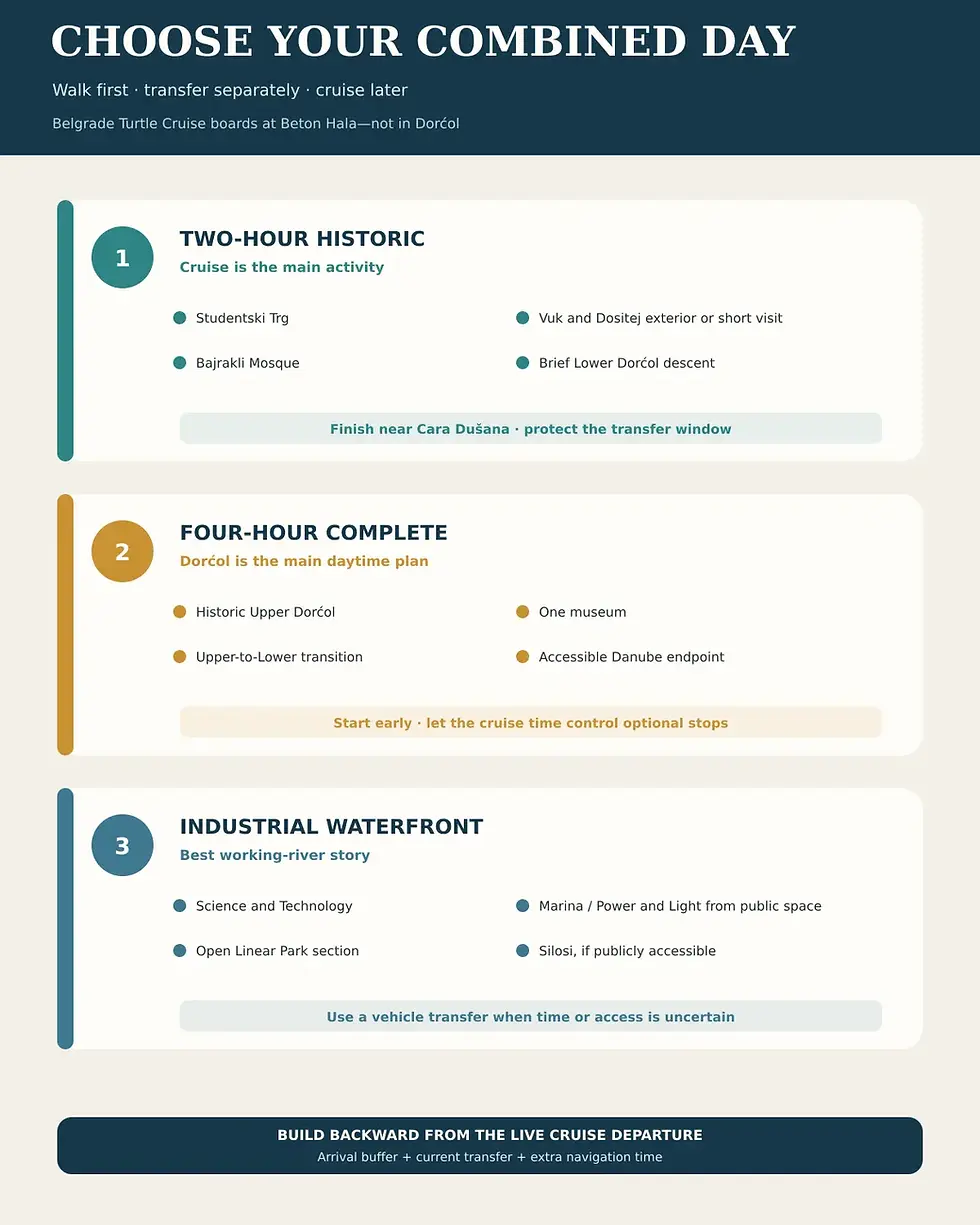
Option 1: Two-Hour Historic Dorćol Walk
Choose this version when the cruise is the main activity.
Begin at Studentski Trg, continue past the Museum of Vuk and Dositej and Bajrakli Mosque, cross the historic streets toward Cara Dušana and descend briefly into Lower Dorćol. Finish with enough time to travel to Beton Hala without turning the walk into a race.
Use the self-guided Dorćol walking route for the complete stop order.
Option 2: Four-Hour Dorćol Itinerary
This version suits visitors dedicating most of the day to the neighbourhood. It includes one museum, the historic streets, the transition into Lower Dorćol and a Danube finish.
The four-hour Dorćol itinerary contains the full timing. Begin early enough that museum delays, coffee stops or construction diversions do not threaten the cruise arrival time.
Option 3: Industrial Dorćol Walk
Start at the Museum of Science and Technology, continue toward Marina Dorćol and the former Power and Light complex from public space, then follow an officially open waterfront section toward Silosi when access is available.
This is the strongest combination for understanding Belgrade as a working river city. Read the complete Industrial Dorćol guide before attempting the route.
Where Should the Walk End?
The best endpoint depends on the version chosen:
Historic route: around Cara Dušana or the Museum of Science and Technology;
Half-day route: an accessible part of the Lower Dorćol waterfront;
Industrial route: Silosi or another officially open riverfront point.
Do not choose an endpoint merely because it looks close to Beton Hala on a map. The fortress, roads, railway remnants, construction and waterfront access can make a direct line impractical.
How to Reach Beton Hala
By taxi or ride-hailing service
This is the simplest choice when the walk ends in eastern Lower Dorćol or when the cruise departure is approaching. Ask for Beton Hala, not “the port” or “Dorćol Quay.”
The final part of the meeting route is pedestrian. After reaching Beton Hala, face the river and follow the promenade toward Bella Vista and the marked Belgrade Turtle meeting table.
On foot
Walking can work if the final waterfront line has been checked and you have enough time.
The route must follow permitted public paths around the fortress and Sava riverfront; do not improvise through port, railway or construction land.
Allow a generous buffer. A route that appears continuous online can be interrupted by works or closed gates.
By public transport
Public transport may be practical from Cara Dušana or central Dorćol, but routes and temporary diversions change. Now (12.10.2026.) bus A2 is your best bet. Check the current journey on the day rather than printing a bus number into an evergreen itinerary.
How Much Time Should You Allow?
Build the day backward from the current cruise departure time:
Plan to reach the meeting point 10–15 minutes early.
Add the current transfer time from your final Dorćol stop.
Add a buffer for construction, traffic or navigation.
End the walk before that buffer begins.
The public sightseeing tour lasts approximately 90 minutes and includes a live guide in English and Serbian and a welcome drink. Departure times move earlier as daylight shortens, so always use the live booking page rather than an old article or screenshot.
A Sample Combined Day
Morning or early afternoon
Studentski Trg
Museum of Vuk and Dositej
Bajrakli Mosque exterior
Cara Dušana 10
Upper-to-Lower Dorćol transition
Mid-afternoon
Museum of Science and Technology, or
waterfront and industrial Dorćol, or
a meal and slower transfer toward Beton Hala
Later afternoon or evening
arrive at Beton Hala;
check in at the marked meeting point;
take the sightseeing cruise through the confluence and toward Zemun.
The cruise schedule should determine how much of the optional middle section you keep.
What If the Weather Changes?
Mild rain does not automatically cancel the cruise, and the boat has covered and indoor seating. Heavy wind, storms or unsafe river conditions may affect operation.
For the walking section, the more immediate problem is exposed riverfront terrain. In poor weather, shorten Lower Dorćol and spend more time at the Museum of Science and Technology before transferring to Beton Hala.
Check current tour communication rather than assuming that rain alone means cancellation.
Accessibility and Physical Effort
Dorćol slopes downward toward the Danube. A route ending on the waterfront is easier than walking back uphill, but older pavements, kerbs and construction can still make the route difficult.
At Beton Hala, access to the boat involves approximately 10–15 older concrete steps and a larger boarding step. Staff can assist passengers with limited mobility, but wheelchair boarding is not currently feasible.
Visitors who find long walks difficult should use a shorter Upper Dorćol route and transfer by vehicle.
Why the Cruise Does Not Need a Hard Sell
After walking through Lower Dorćol, the river already feels central to the story. The cruise simply changes the viewpoint.
From the boat, the fortress is no longer an isolated monument, Great War Island is no longer a green shape on a map and Zemun’s church towers and Gardoš become part of the same river corridor. That geographical clarity is the reason to add the cruise-not because every neighbourhood article requires a booking link.
Check the current departure time and availability on the Belgrade sightseeing cruise page.
Frequently Asked Questions
Can you take a river cruise from Dorćol?
Belgrade Turtle Cruise does not board in Dorćol. Its meeting point is at Beton Hala on the Sava riverfront.
Should I walk through Dorćol before or after the cruise?
Walking first is usually easier because the neighbourhood’s museums and heritage sites operate during the day, while the cruise often works well later in the afternoon or around sunset.
How long should I spend in Dorćol before the cruise?
Allow two hours for a compact historic walk or approximately four hours for one museum and a Lower Dorćol finish.
Can I walk from Lower Dorćol to Beton Hala?
It may be possible using public waterfront and fortress-side paths, but the exact route must be checked for construction and closures. Use a taxi when time is limited.
Is the boat wheelchair accessible?
No. Approximately 10–15 concrete steps currently prevent wheelchair access, although staff can assist some passengers with limited mobility.
Does the cruise show Dorćol?
The cruise helps explain Dorćol’s position within the wider river landscape, but it is not a close architectural tour of the neighbourhood’s streets or industrial sites.


Comments